




Bruno
58 likes
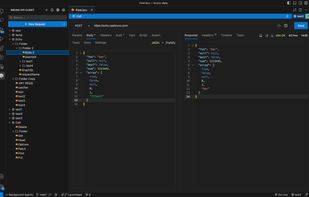
Lightweight open source API client offering offline API testing, local filesystem storage via plain text, version control compatibility with git, intuitive request management, privacy-first design, cross-platform support, minimal resource usage, and community-driven development.

Cost / License
- Freemium (Subscription)
- Open Source (MIT)
Application typeApplication types
Platforms
- Mac
- Windows
- Linux
- Snapcraft
- Flathub
- Visual Studio Code


Features

Bruno News & Activities
Highlights All activities
Recent News
- Fla published news article about Bruno
- Fla published news article about Bruno
- Fla published news article about Bruno


Recent activities
- kulatynesmysl liked Bruno
 RedfireForge added Bruno as alternative to RedfireForge
 riturajshakti added Bruno as alternative to Telegraph REST API Client
- Jose-David-Vite-Bautista liked Bruno


Featured in Lists


What's on my 2024 Linux Laptop
A list with 52 apps by amenthes without a description.


Xenmaster's 2026 Front-End Web Development Catalog
This list is an update to the list I created seven years ago https://alternativeto.net/lists/8008/front-end-development/. The web and development has changed a lot since then and rather than re-write history, decided to create a new list based on current patters and shifts in enterprise environments. These details are based on both what I've seen in the professional world as well as for hobbyists and web development enthusiasts who run their own projects.
In addition to consulting the documentation for each of the tools below, I'd like to shout out the following projects which also played a big part in informing the overall structure of this list:
Jeff Delaney's 100 Second Videos: https://www.youtube.com/@Fireship
Kamran Ahmed's Roadmaps: https://roadmap.sh
Devographics's State of JavaScript 2025 Survey: https://2025.stateofjs.com/en-US
Note that I don't plan on covering anything AI related for the development process. If I did, the list would have two items: Claude-Code, and Sonnet. Using these tools, it's easy to build out slop that won't work reliably which you don't understand and can't maintain.


Xenmaster's 2026 Back-End Web Development Catalog
This list is an update to the list I created seven years ago https://alternativeto.net/lists/8010/back-end-web-development/ which focused on the server-side aspect of web applications. The web and development has changed a lot since then and rather than re-write history, decided to create a new list based on current patters and shifts in enterprise environments. These details are based on both what I've seen in the professional world as well as for hobbyists and web development enthusiasts who run their own projects. The general pattern for back-end development will cover three main points for each function:
Self Hosted Option
Third-Party Service Option
AWS Option
I also cover any GUI interfaces available for folks who don't want to interact with these services using a terminal.
In addition to consulting the documentation for each of the tools below, I'd like to shout out the following projects which also played a big part in informing the overall structure of this list:
Jeff Delaney's 100 Second Videos: https://www.youtube.com/@Fireship
Kamran Ahmed's Roadmaps: https://roadmap.sh
Stack Overflow's Developer Survey: https://survey.stackoverflow.co/2025/
The beginning of this list will cover some common languages used to build server-based APIs for web applications, including Python, Javascript, C#, and Go. Honorable mentions, some of which were from my original list, include the following:
Rails with Ruby: one of the best developer experiences but counterbalanced by terrible performance from a speed and efficiency perspective. This framework is still really popular in India.
Spring Boot with Java: A very common enterprise-based application framework and particularly popular in China. But it requires Java, which I wouldn't wish on anyone.
Laravel with PHP: PHP gets a lot of hate, but I used it back 20 years ago and am still fond if it. PHP is generally useful for Wordpress-based sites too. Has performance issues though since it is an interpreted language.
Phoenix with Elixir: Also a great developer experience and is very popular on the Stack Overflow survey. Only reason I can't recommend is because you will be learning Elixir just to use Phoenix because it isn't a language really used for anything else mainstream.
Note that I don't plan on covering anything AI related for the development process. Of Generative AI, wickedest of technological inventions, I shall neither speak nor give direction.
What is Bruno?
Bruno information
Developed by
 Bruno Software Inc.
 Licensing
Open Source (MIT) and Freemium product.Pricing
Subscription ranging between $6 and $11 per month + free version with limited functionality.Written in
Rating
Average rating of 4.3Alternatives
55 alternatives listedNews
6 news article related to BrunoBadge
Get an embeddable badge for BrunoSupported Languages

AlternativeTo Categories
Development, OS & UtilitiesGitHub repository
- 47,197 Stars
- 2,922 Forks
- 1845 Open Issues
- Updated


Comments and Reviews
The interface, like Postman, is simple as straightforward. In fact, the interface is a lot lighter and it doesn't demand a lot of resources of your machine. I wanted to move away from Postman as they started to store your collections and request config in the cloud. Bruno doesn't - it's all local.
With the file system structure you can push it all to a Git repo to enable collaboration, which is a premium feature in Postman.
I'm not sure of feature parity between the two, but Bruno easily fulfils my requirements.
In the free version, you have less features than in Insomnia or Postman ...
As "lightweight" as an Electron app can be, still using 800MB just idling.
Postman, insomnia and other crap insist on online accounts and hide the export feature to nudge you into using their online services. Bruno straight up asks you where to save the files and updates them as you work. Easily integrating with your version control system.
Its interface is similar to postman, allows collections, is MUCH lighter and does not require login. Much better than postman.
Pro: + Interface is very similar to Postman + Completely offline + Client is open source + Actively updated. + Light weight. + MIT License + Easy to integrate with version control unlike Postman where a collection is combined in a single file.
Con: - UI/UX needs more refining. - Closed source "Premium (Golden)" edition - Missing translations
It's so much better than Insomnia or Postman. Postman is too much business focused and insomnia is just very very slow. While Bruno is small, fast, responsive and easy to use. It's fully open-source and does not require any login/account.
Thus exactly what I wanted!! Bruno even has Debian package repository. I'm not sure what more to ask for.