


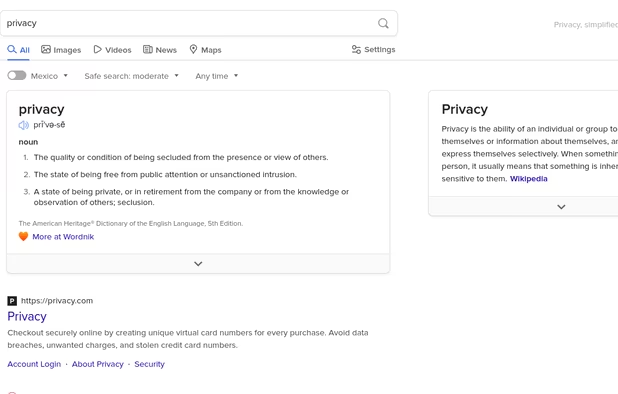
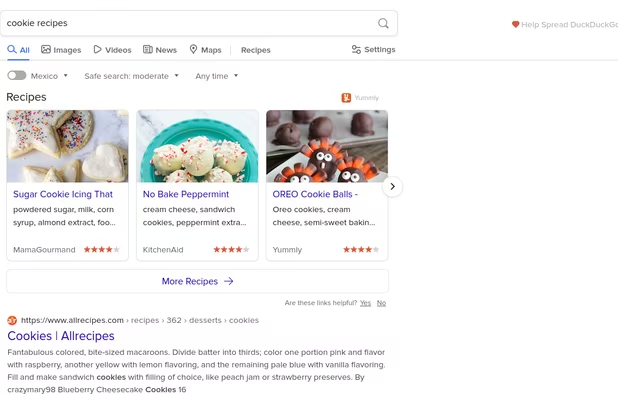
Privacy-focused search engine offering Zero-click Info, instant answers, and more, built from open-source software for a user-friendly experience.
Cost / License
- Free
- Proprietary
Application typeApplication types
Platforms
- Online
- Microsoft Edge
- Google Chrome
- Tor
- Opera
- Mozilla Firefox
+16

Privacy respecting search engine. You should definitely replace your current one with something that doesn't track you.















Comments
You forgot about these: Privacy oriented Browsers: Epic Browser SRware Iron Ghost Browser Brave Browser Vivaldi Browser ... not seen as a privacy browser but is far more private than most chromium browsers, uses own sync system and does not collect data in batches nor do they sell them Opera First browser to feature a built-in VPN to keep all of your info secure and hidden
Privacy Oriented Search Engine: Startpage Qwant Searx
Password Manager: Myki (imo is better than Keepass and allowing another app sync your documents, Myki is offline and syncs with your devices without storing it in the cloud or their servers. They hold absolutely no info on you apart. As well has a built in 2FA. Less apps you use the more private you are.)
Texting: I wouldn't use Telegram for lots of reasons, it had/has tons of privacy security issue, just need to search it. Tox Project even if it's in beta it still a good competitor to Signal. Actually just search Signal on Alternativeto and the first like 15 apps or so are pretty secure and very privacy oriented
Web Extension: Adguard holds more adblock rules, and is surprisingly in a smaller package than other adblocks Silent Mode, blocks all if not most trackers and even protects your identity like what OS you are using, if it's 32 vs 64 bit and much more.
[Edited by artexjay, December 27]
I wanted to only list some of the most popular / easiest to use alternatives to popular products / services, and not list every single alternative, since that's imo the job of alternativeto :)
Telegram was included because it's easy to use, not because it's secure for sure. But if someone wants to migrate away from Facebook / Google, it's at least a good start. But I understand that I could have focused a bit more on the controversies with it.
While privacy oriented browsers do exist, I've find those in the past to lack a lot of features when compared to FF/Chrome, and generally I cannot recommend them because I've not tired them (I mean I tried Vivaldi but I wouldn't call that privacy focused, and found it to be quite a bit slower than Firefox). And with Firefox you can go to about:config and turn off pretty much all data being sent to Mozilla. Librefox (https://github.com/intika/Librefox) is a quick config that I personally use.
As per password managers, I know that there's a lot of solutions out there, but keepass stands out to me as the best privacy / security focused one because of the open source nature of it, and also that it's well maintained and has at least a bit of popularity. And the fact that the database never even leaves your computer without you yourself setting that up is imo a good thing, because that means that it's harder to even get anything to try to hack.
While adguard might hold more adblock rules by default, you need to note that uBlock does support custom rules (and a lot of them exist, and a lot of them can be found from https://filterlists.com/ ). And as far as I know, uBlock is one of the most performant adblocking solutions out there. Not to forget that it's open source, meaning that you can audit it yourself if you have privacy / security concerns. And uMatrix is a really safe bet if you disable scripts by default, since there's not a ton of data that a website can gather from just a http request.
But I do admit that this is by no means an extensive list. For example I could've included nano defender (https://jspenguin2017.github.io/uBlockProtector/) also. Or browserplugs (https://www.browserplugs.com/). But those aren't really that much alternatives anymore, and more like stacking privacy features on top of already existing privacy features.
Adguard can holds custom rules as well. And personally see adguard as a superior adblocker to Ublock, for a tons of reasons, one being a much more friendly user interface.
For browsers i find FF to be the slower in opening and browsing compared to it's chrome counterparts some of them being Vivaldi and Opera. Although I do agree that Vivaldi's primary focus isnt privacy they still end up having an excellent browser if you want to keep chrome like functionality. Epic for example does not gather any info on you neither does Iron.
Keepass is decent, but still see Myki as the superior one as I have stated before it's also an offline password manager BUT has similar capabilities to that of a cloud password manager, encrypts your data then sends it via an encrypted channel via LAN to your extension on any PC connected.
Telegram I do not view as an FB alternative rather it's just a messaging app so a Whatsapp alternative in fact. There are plenty of more secure messaging apps out there.