




Passbolt
30 likes
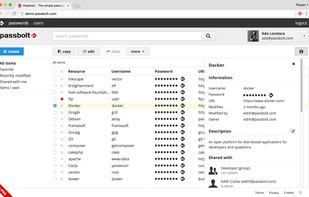
Passbolt is an open source password manager for teams. It allows to securely share and store credentials. For instance, the wifi password of your office, or the administrator password of a router, or your organisation social media account password, all of them can be secured...

Cost / License
- Freemium (Subscription)
- Open Source
Application typeApplication types
 EU
EUPlatforms
- Mac
- Windows
- Linux
- Android
- iPhone
- Self-Hosted
- Microsoft Edge
- Google Chrome
- Software as a Service (SaaS)
- Mozilla Firefox


Features
Passbolt News & Activities
Highlights All activities
Recent News
- Paul published news article about Passbolt
- Fla published news article about Passbolt
- Fla published news article about Passbolt


Recent activities
- Derek Moore liked Passbolt
 Paul added Passbolt as alternative to Sesame Password Manager
- Markus Lind added Passbolt as alternative to NativePass
- Wierzciu liked Passbolt
 jsussanchez added Passbolt as alternative to Easy Pass Login


Featured in Lists



Europe’s Open-Source Solutions: Your Guide to Transparent, Independent and GDPR-Aligned Software.
This guide is designed for anyone looking to take greater control of their digital life by choosing open-source solutions developed and maintained within Europe. It highlights projects that promote transparency, reduce reliance on non-European tech ecosystems, and align with Europe’s strong commitment to privacy and data protection. The goal is to support digital autonomy in Europe while uplifting the local developers and communities who build trustworthy, user-centric software.




Open-Source Slopware
A list of open-source software containing slop (LLM generated) code or endorses the usage of LLMs in other ways.
This list contains software that obviously accepts irresponsible coding practices or promotes LLM usage. I found these applications while searching for alternatives to previously used software that turned out to contain code generated by slop-machines.
Each of added applications have at least one link that points to the verifiable proof.
This list by no means is meant to cover all the software that contains code by not-so-intelligent tools and people using them but to serve as a reminder to myself about what I have already checked.
Why having LLM generated code (and using generative tools in general) is bad?
Ethical reasons — such as illegally retrieved training material, underpaid workers that prepare the training data.
Impact on environment — increased fossil fuel usage to supply the needed electricity power, water usage in water scarce regions. This somewhat overlaps with the above.
Social impact – noise pollution in neighbourhoods near AI data centres, air pollution from diesel- or gas-powered turbines (also overlaps with the above), resource consumption by data centres drastically increases utility prices.
Impact on brain and thinking, reasoning — by offloading thinking and decision making to machines people are shooting in their foot (more like in their head) as this leads to brain rot. Less intelligent people are easier to control.
Even legal issues (especially in open-source software as it cannot be guaranteed that the “generated” code is not really just re-used, thus unknowingly violating the source license).
Inevitable enshittification — every software product from big technology eventually gets enshittified to maximize revenue. For users this could mean hidden or plain ads, biased opinions/information, privacy violations, increased prices for LLM based tools.
Burden on open-source software maintenance — LLM tools provide easier access to code contributions which often shifts the responsibility of checking code quality from developers to maintainers and reviewers. Digging through walls of merge request text and code generated by slop-machines takes valuable time that otherwise could be spent more meaningfully by fixing bugs and working on new features.
I will try to add links that back up the claims above, but it may take a while.
Of course, I see how and where generative tools could be helpful and sometimes I feel tempted to find an acceptable way to use them, but for now the direct and indirect costs far too much outweigh gains.
This list has its positive counterpart: Slop-Free (Supposedly) Open-Source Software (not quite complete yet).
Also take a look at and give thumbs up to AI Slopfree Software Catalog which contains software dedicated against usage of LLMs.
Also, here is a list of some labels that can be added / voted for so they would eventually appear on application pages:
Slopware;
Slop (LLM) Code;
Slop-Source Software;
Open-Source Slopware;
Contains Slop (LLM Generated) Code.


Self-Hosted.
A list with 9 apps by RemovedUser without a description.


What is Passbolt?
Passbolt information
Developed by
 Passbolt SA
 Licensing
Open Source and Freemium product.Pricing
Subscription ranging between $19 and $45 per month + free version with limited functionality.Alternatives
221 alternatives listedNews
5 news article related to PassboltBadge
Get an embeddable badge for PassboltSupported Languages
AlternativeTo Categories
Security & Privacy, Office & Productivity, Remote Work & EducationApple AppStore
- Updated
- 4.81 avg rating


Comments and Reviews
Passbolt is a self-hosted password management web app written in PHP featuring end-to-end encryption using GNUPG keys. It provides web browsers add-ons and a Windows desktop app. It allows sharing of individual passwords or password folders with other users or user groups. When used daily, the app is slow to provide a password and doesn't allow to bind a password to other URLs (for Stack Exchanges sites, or for an Android app). The user experience isn't ideal.
Installation always fails on compliance_check which is not required (you can comment out the line BTW).
Additionally to use the vault you need to install a Chrome App? Where is the security in this password vault additionally the portability??
Don't waste your time install it
A BIG NOPE
There is a nice documentation that describes how to install it. The web interface is really good. I am still testing Passbolt, but it seems a nice tool to keep and share password with security.
Passbolt is web based and designed for teams!