


Nextcloud
1280 likes
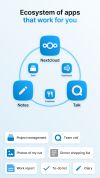
On-premises solution offering file sync, universal data access and collaboration through Nextcloud Files, Talk, and Groupware. Ensures secure, controlled data storage for enterprise with powerful privacy tools including encryption, fine-grained access, and a bug bounty.



+5

Cost / License
- Free
- Open Source (AGPL-3.0)
Application typeApplication types
 EU
Since
- Since 2016
Releases
- 35 releases last year35 last year
GitHub
- GitHub stars: 37.6k
Features




Highlights All activities
Nextcloud News & Activities
Recent News
- Paul published news article about Nextcloud
- Mauricio B. Holguin published news article about Nextcloud
- Mauricio B. Holguin published news article about Nextcloud Hub


Recent activities
- mtje-mtto liked Nextcloud
- Dantes V-NoWar Earthling liked Nextcloud
 dutch03 added Nextcloud as alternative to JuiceMount
It’s nice that it exists at all. However, the company’s policy runs counter to ethical principles, as demonstrated by the OnlyOffice incident, which undermines trust in the app. Also, when I logged into the NextCloud client, I was met with an interface that was simply appalling due to how outdated it was (hello, 2015).
 LibreFan added Nextcloud as alternative to PrivateStorage
- Net Ops (pro) liked Nextcloud
 Mohamed Asarudeen added Nextcloud as alternative to MirrorFly IM
- jonas-bonas liked Nextcloud




How to live without Google
For many the Internet is Google: Search, mail, videos, web browser, cloud services, mobile OS, etc. – Google is the major player in all these fields. But Google uses all data it gathers across its services to post targeted ads, and to massively profit from the data many share so freely with the Internet giant. Your personal data can also be subpoenaed by lawyers, including for civil cases like divorce. Google answered over 200,000 such data requests in 2020 alone.
More and more people are also realizing the risk of relying on one company for so many personal services. So, the time has come to stop this unlimited data mining and to take back our right to privacy. Here's a quick guide as to how you can use the Internet without sharing all your data with Google.


Interesting and open-source Android apps
A list of interesting and open source Android apps.



Into the Cyberverse
The ultimate list of apps/services for better Security, Privacy & Anonymity; Defense against Surveillance.
What sets this list apart is its commitment to authenticity:
No Sponsorship: Choices are made without commercial bias.
No Affiliate Links: Purely user-benefit-focused.
No Brand Deals: Independent and unbiased evaluations.
Strict criteria ensure the tools prioritize user welfare and software quality:
Opensource Preference: Prioritizing transparent and community-driven software.
Cross-Platform Availability: Emphasizing tools usable across multiple systems.
Active Development and Security Updates: Selecting only actively maintained tools with regular security enhancements.
Proven Track Record: Requiring a history of reliability and positive feedback.
Official Links


Install from the command line
winget install -e --id Nextcloud.NextcloudDesktopbrew install --cask nextcloud
Developed by
 Nextcloud
Licensing
Open Source (AGPL-3.0) and Free product.Pricing
One time purchase (perpetual license).Written in
Rating
Average rating of 4.6Alternatives
194 alternatives listedNews
16 news articles related to NextcloudBadge
Get an embeddable badge for NextcloudSupported Languages
AlternativeTo Categories
Office & Productivity, Backup & Sync, Security & Privacy, File Sharing, Development, File Management, Photos & Graphics, Remote Work & Education, Social & Communications, Audio & Music, OS & Utilities, News & BooksApple AppStore
- Updated
- 4.68 avg rating
GitHub repository
- 37,603 Stars
- 5,379 Forks
- 4,015 Open Issues
- Updated




Comments and Reviews
I use Nextcloud for my computer club, and it works great, without any problems!
It’s nice that it exists at all. However, the company’s policy runs counter to ethical principles, as demonstrated by the OnlyOffice incident, which undermines trust in the app. Also, when I logged into the NextCloud client, I was met with an interface that was simply appalling due to how outdated it was (hello, 2015).
Solid free swap for Dropbox if you can run a server, or know someone who can. Tip: let Dropbox finish syncing to your computer first, then copy with rclone or rsync instead of dragging files into the web page. The catch: every old Dropbox share link stops working when you cancel, with no redirect, and old version history doesn't come with you.
I've run Nextcloud in production on my own hardware for over 3 years, and I use it daily for two companies, my family, and a nonprofit. I self-host it, so this is written from the admin side, not as someone who tried a hosted demo for an afternoon.
What it actually replaces: Google Workspace and Microsoft 365, mostly. Files, calendar, contacts, and Talk for meetings. Once your photos and documents are in it, the sync clients on desktop and mobile are genuinely fine, and the "my data is on my hardware" feeling is not a small thing.
What it does well: file sync and sharing including public share links that actually work. Groupware good enough to leave Google Calendar behind. The app ecosystem is real, so it stops being just a file server. And data ownership. You can export everything. Nobody can revoke your account.
Where it's genuinely hard, and you should know this before you start: setup and upgrade maintenance are the real cost, this is not a one-afternoon install if you want it reliable. Performance tuning matters, default database and PHP settings are not enough once you have real volume, and if you skip it you'll conclude the sync client is slow when the real problem is the server. Apps can break each other on major version upgrades.
Who it's right for: anyone serious about owning their stack who will either learn the maintenance or pay someone to handle it. The software is free. The labor is not.
Who it's wrong for: someone who wants set-and-forget Dropbox. Self-hosting means you are the vendor now. That is the point, and it is also the job.
Better than Google Drive
It's one hell of a multitool to move your digital infrastructure to a provider of your choice, including yourself if you have the reasonably small set of skills to set it up. While the core only handles file sync and sharing, it also has an app system which expands its scope practically as far as you want: calendars, contacts, tasks, messaging, document collaboration… said app system, however, is decent, but not great. Apps outside of the most popular ones don't update very often, and this can hold back the upgrades of Nextcloud itself. And its roots in PHP complicate first-time setup to this day, starting with the awkward choice between Apache and nginx. The AiO container was probably meant to solve this, but last I checked, I could neither migrate my existing container installation to it without a lot of tinkering under the hood, nor have it alongside other applications on the same machine. It's all solvable and once you've got it running it will probably just work for years to come (like it did for me). It comes with good security defaults, a checklist to clear and a good pluggable mechanism of two-factor authn.
Been waiting to post review for years. But now it's clear - they abandoned plans to make working autoupload feature, which is most important feature. It's still lagging, freezing, missing lots of photos, if you have more than few photos to autoupload and near empty directory on the server. It's to soft to say that it's unreliable.