


Windows 10
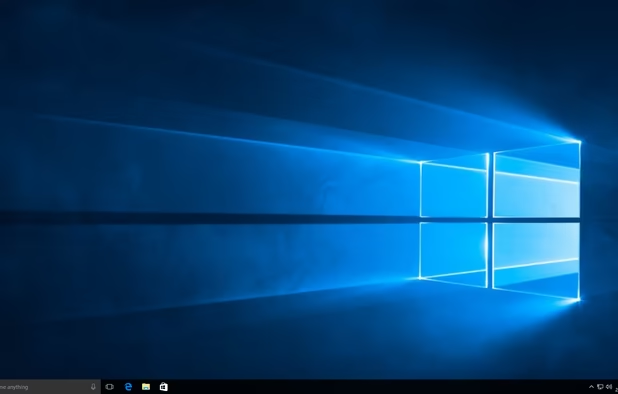
Versatile OS with universal app architecture, free first-year offer for Windows 7 and 8.1 users, redesigned mouse-touch UI, virtual desktop, Microsoft Edge, upgraded security, and enhanced graphics for gaming, supporting fingerprint and face recognition login.
Cost / License
- Pay once
- Proprietary
Application type
Alerts
- Discontinued
Platforms
- Windows
After October 14, 2025, Windows 10 will no longer receive free software updates, technical support, or security fixes. Microsoft suggests to upgrade to  Windows 11 : https://blogs.windows.com/windowsexperience/2024/10/31/how-to-prepare-for-windows-10-end-of-support-by-moving-to-windows-11-today/

Features
- Auto Update
- Usability

- PowerShell Scripting
- Works Offline
- Tablet support
- Dark Mode
- No registration required
- Xbox Streaming
- Binary packages

Windows 10 News & Activities
Recent News
- Maoholguin published news article about Windows 11
 Microsoft disables yet another offline Windows activation option, pushing online only
Microsoft has reportedly ended support for phone-based product activation in Windows and Office, qu...
- Maoholguin published news article about Windows 10
 Windows 10 extended security updates are now free in Europe with no OneDrive requirement
Windows 10 will officially reach its end of support on October 14, 2025, and while Microsoft had in...
- Maoholguin published news article about Microsoft PowerToys
 PowerToys 0.94 launches with new settings search, conflict alerts, gliding cursor & more
Microsoft PowerToys version 0.94 introduces a settings search capability, accessible via Ctrl+F or ...


Recent activities
 AnonUser added Windows 10 as alternative to Ageless Linux
 POX added Windows 10 as alternative to VitruvianOS
 lamjed001 added Windows 10 as alternative to XeroLinux
 VolodiaKraplich added Windows 10 as alternative to PrismLinux
- berryboiii liked Windows 10
 Alaik added Windows 10 as alternative to Astral OS
 TTXTrick added Windows 10 as alternative to ONU
- kelsonv reviewed Windows 10
It's at least usable. Much better than Windows 8, certainly, if not as solid as Windows 7. And it hasn't gone as far into "YOU are the product" as Windows 11 has, even if it's gone farther than I want it to. (So. Much. Upselling.)
I actually downgraded a Microsoft-made tablet from Windows 11 back to Windows 10 a few weeks ago because it ran so much slower on the newer OS, and enrolled in the extra year of security fixes. That gives me a year to check out the state of driver support in Linux...


Featured in Lists

These are all the software I use on my windows machine. I am privacy freak. So, I mostly use open source software. …

Master List of all Apps and Software I use for both work and personal life.

A list with 807 apps by AmileyaRyver without a description.
What is Windows 10?
Windows 10 is a personal computer operating system released by Microsoft as part of the Windows NT family of operating systems
To encourage its adoption, Microsoft announced that during its first year of availability, Windows 10 would be made available free of charge to users of genuine copies of eligible editions of Windows 7 or Windows 8.1.
Windows 10 introduces what Microsoft described as a "universal" application architecture; expanding on Metro-style apps, these apps can be designed to run across multiple Microsoft product families with nearly identical code—including PCs, tablets, smartphones, embedded systems, Xbox One, Surface Hub and HoloLens.
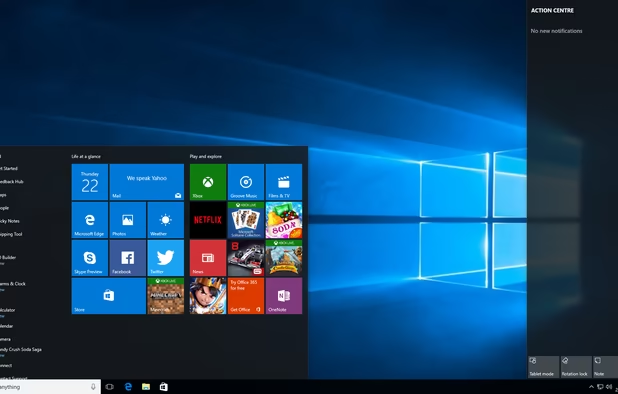
Windows 10's user interface was revised to handle transitions between a mouse-oriented interface and a touchscreen-optimized interface based on available input devices—particularly on laplets; both interfaces include an updated Start menu that comprises a design similar to Windows 7 with 8's tiles.
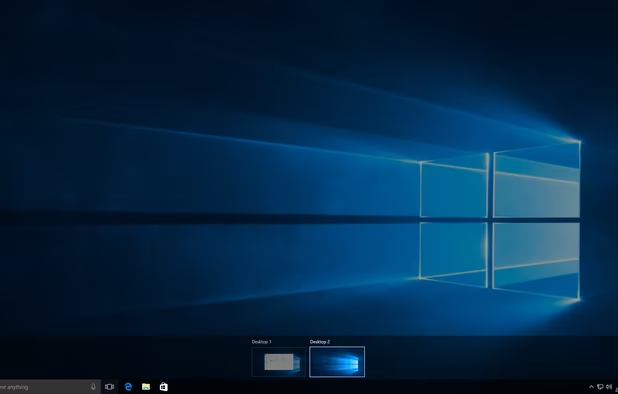
Windows 10 also introduces Task View, a virtual desktop system, the Microsoft Edge web browser and other new or updated applications.
Integrated support for fingerprint and face recognition login, new security features for enterprise environments, DirectX 12 and WDDM 2.0 to improve the operating system's graphics capabilities for games.
Windows 10 information
Developed by
 Microsoft
 Licensing
Proprietary and Commercial product.Pricing
One time purchase (perpetual license) ranging between $140 and $200.Rating
Average rating of 2.4Alternatives
181 alternatives listedNews
54 news article related to Windows 10Supported Languages
- English


Comments and Reviews
I have been a Linux user and kernel developer for years. I was a very skilled user of cli, vim, tmux, etc., you name it. But I still find Windows 10 to be the best and finally switched back to Windows. I don't understand why so many people hate Windows so much. Linux is just not a substitute for Windows, lacking so many powerful apps and drivers, including the widely hated Office (LibreOffice is just not a substitute for it, face the truth). Even a skilled CLI user like me will find the command line configuration exhausting, not to mention novice users. Microsoft is not making billions of dollars from Windows and Office without a reason.
Though, the battery consumption is just unbearable in Windows. And I appreciate the security, privacy, clarity, file system, flexibility, scripts, low resource usage and CLI of Linux, especially if you are a developer. But I just think there is no need to hate Windows and overrate Linux, not to say who is better or worse, they just serve different purposes. If you are using an OS for your daily life without programming or specific tasks, use Windows, it's the right choice.
Why Microsoft spy on their users
Google, Facebook, Amazon and others have adopted a business model in which huge databases are constructed about their users' contacts, who and when they talk/email/chat, what about, what files they store, calendar contents, search history, bookmarks, posts, likes, where/when you go physically, what they read and buy... and on... and on.* Doing this allows them to know their users in incredibly intimate detail. They are then able to promise advertisers that their ads can be targeted with huge precision because they know who to display specific ads to. This is where many modern billions are made.
In this context, Microsoft have a distinct advantage: a world-wide near monopoly on desktop operating systems. They have chosen, via Windows 10 and retroactive updates to Windows 8 and 7, to make use of this monopoly. Windows 7, 8 and 10 now gather gigantic amounts of data about Windows users. In this way, Microsoft can potentially out-compete Google, Facebook and the rest. (That means you are not avoiding Microsoft's violation of your privacy by staying on Windows 7 or 8.)
What Microsoft's Windows collects about users
Recent EU pressure on Microsoft about its privacy practices (including over the 2017 Creators update) seems to have forced them to reveal which "telemetry" data Windows 10 gathers. It includes, but is absolutely not limited to:
... and all of this in addition to the data you give them if you have a Microsoft account:
Note also, that if you use Microsoft's email services, e.g. Outlook, or other services, like LinkedIn, they can correlate all of this information with what you email, when you email it and to whom and who you know.
Note that if you store other people's contact details or private information on your Windows machine, all of this in principle can be monitored by Microsoft. For example, if you search in your computer (locally) for a name that has someone's personal details (e.g. name, address, National Security Number), all of this can be sent to Microsoft servers. Microsoft is therefore not only using your privacy for their profit by amassing your details into a database, but also that of people you may know, contact or whose details you might be responsible for, even if they never agreed to Microsoft's Terms and Conditions or Privacy Policy.
Microsoft categorize the telemetry settings into "Basic" and "Full", and claim that user data collected is not personally identifiable. This is misleading. Firstly, the Basic level collects 90% of what the Full level collects, so it's does not give users meaningful control. Secondly, at least according to one former Microsoft employee, Jerry Berg, Microsoft databases are easily cross-linked and therefore it is trivially easy to correlate telemetry gathered via Windows to, e.g. telephone numbers and mobile phone sim card numbers, and vast amounts of other types of personally identifiable data.
Why It is Wrong & Dangerous
Microsoft push updates to Windows computers and with them install ever-increasing levels of spyware ("telemetry") from which users cannot, effectively, opt out. This applies to paying customers. Microsoft already has their money; but it wants to make more by violating your privacy and freedom to say no.
When you read the End User Licence Agreement that every Windows installation requires, you realize that Microsoft retain the right to control your computer. Whilst you might, on a day-to-day level feel that you are the computers owner, it remains nevertheless true that Microsoft can download and install software onto your computer against your wishes, reset your preferences and much else besides. This means that your computer becomes a node for software you might not want, but for which you paid to have the privilege of not controlling. This is unethical because it gives control of your machine to Microsoft. However much control you have, they have more.
Microsoft updates - the recent Creators one included - resets many user preferences, such as which browser is default. In effect, this is saying they don't care about what you like; they will try any and every trick to get you to use their preferred apps instead of those you chose. Again, the reason for this is because their apps give them enhanced levels of information about what you are doing on your own computer.
All data Microsoft collects and stores about its users can be subpoenad under NSL and FISA legislation in the US, and this applies to information about non-US citizens. So Microsoft and the American government (and companies they sub-contract, e.g. to analyze the data) can know everything about you, even if you are not American and have never even been to the US. And, of course, you have no choice to opt out. Because it is true that Microsoft control your computer (see point 2 above), your computer effectively becomes a spyware device for both the company who stand to profit (Microsoft) and US federal agencies, like the FBI, who can - in principle at least - force Microsoft to use your computer to spy on you. If you doubt this relationship between large US firms and the feds, read about how Yahoo wrote software for the FBI to search through all their users emails. Yahoo has also had hundreds of millions of accounts hacked, and some have alleged this was made possible by a security exploit introduced by the feds.
Databases of private people of the type Microsoft is creating are ripe for huge abuses. Please observe that every totalitarian government in history has aimed to manipulate citizens by gathering information about them. For any kind of political power to know what its citizens are thinking, what they are saying, where they are going, with whom they are meeting, what... all of this is a problem because:
The only way to avoid all of these problems is not to create such databases in the first place.
(You should also know: previous independent programs/apps distributed by individuals aiming to help people switch of Windows telemetry are now unlikely to work because of "under-the-hood" changes the recent Creators update includes.)
What you can do about Windows spying
If the databases continue to be created, as individuals we have the choice (still) to opt out by not using products that treat us this way. If you don't have to use Windows (and most people reading this probably don't have to), then I cannot possibly recommend anything other than to switch away to an operating system that doesn't spy on you. Note that some of what Windows does, Apple's MacOS also does. For example, Apple's desktop search app, Spotlight, records the search terms you use on your own computer. (You can disable this, but then you disable the search.)
Operating systems that do not spy on users include Linux and BSD. Of these, Linux is by far the more popular and comes in many different flavors, including user-friendly versions for beginners (e.g. Ubuntu, Linux Mint, OpenSuse and even Manjaro). They are also free, open-source (which means the code can be trusted) and have huge communities of people happy to help newcomers. There are general Linux forums and distribution specific forums. Modern Linux distros are now largely so usable and stable that a beginner would only really have to relearn a couple of basics about what some new icons do and where some folders are that they might not be used to. That's about it. It is also possible to run Linux with Windows in a virtual machine for programs that don't have a Linux equivalent (although most do).
Other fantastic resources online that you can use to learn more about protecting your privacy are:
The other thing to do is to campaign against what Microsoft (and Google, Facebook, etc.) are doing. Contact your local representatives, politicians, MP or MEP and get them to kick up a fuss about this. You can also
Last updated: 2017-04-20
Well said, well written, nothing to add. Welcome to the world of the Gafam...where every move you make, every step you take, THEY'LL BE WATCHING YOU...MESSAGE IN A BOTTLE...
If you play video games you can't avoid windows . I care about privacy , even though more than some others , performance is the most important for me , and btw I hate linux
btw i meant less instead of more and i cant edit but hey who cares everyone got it and thanks for the likes
It's at least usable. Much better than Windows 8, certainly, if not as solid as Windows 7. And it hasn't gone as far into "YOU are the product" as Windows 11 has, even if it's gone farther than I want it to. (So. Much. Upselling.)
I actually downgraded a Microsoft-made tablet from Windows 11 back to Windows 10 a few weeks ago because it ran so much slower on the newer OS, and enrolled in the extra year of security fixes. That gives me a year to check out the state of driver support in Linux and tablet-friendly distros.
Oh my god... Windows 10 is starting to fall apart from security updates.
From my perspective, I hate this. Microsoft is ruining the operating system I used daily because it felt so slightly reliable than bloated Windows 11. Now I have to switch it, and it feels so unreliable... where so many bloated things I really don't use. At least I had that knowledge to debloat that freaking messy proprietary operating system into the possibility I will be using daily. At least I still had knowledge on installing Linux Mint or Arch Linux alongside Windows.
I don't want to get watched by horrible spyware where my movements get tracked! I don't want to sign in with a Microsoft Account! I just want to live in peace, but I can't.
Unfortunately I still need to do things efficiently in Windows because some applications I used for daily that is not compatible with Linux. For example, I used CapCut (Old Version) to edit videos to get things done. I played Roblox just to immerse myself into the virtual world to spend some of my free time for fun. These that I'm currently using so I can put my work through and move on!
I hope Linux grew stronger with a lot of compatibility where I can run Windows applications and everything else! Even my writing has few issues, or it's bad itself, I still do anything in power to give it and Windows 11 a one-star rating.
just bad - spying, bloatware, close source
Certain games still can't be played on Linux because of the anti-cheat. I wouldn't do anything other than gaming on this OS. Microsoft spyware.
It has native spyware, and it isn't FOSS.