OpenChronology is a free and open-source timeline editor for exact dates at any scale, from deep time to fractions of a second. Every time is stored as an exact fraction rather than a floating-point number, so dates before year 1, spans of billions of years and single seconds can sit on the same timeline without rounding.
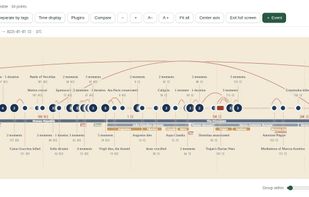
Timelines are made of moments (points in time) and durations (spans with a start and an end), which can be linked to each other with relationships. Events can carry notes in Markdown, tags, images, sources, and other arbitrary metadata, and a precision setting records how exactly each date is known. Times can be shown as calendar dates, plain numbers, scientific units or a custom format. Timelines of up to 200,000 moments stay responsive, with nearby events grouped as the view zooms out.
Public timelines can be read without an account and embedded on other sites, and each event has its own page. Several timelines can be compared side by side or combined on one axis. Collaborators can fork a timeline and propose changes as pull requests, with discussion and saved history.
Other features include importing log files (syslog, nginx, Apache, JSON lines and the systemd journal) into timelines, a live syslog receiver, causal-factor charts for incident and accident investigations, a plugin system, and an HTTP API with an OpenAPI description.
OpenChronology runs in the browser at timescale.info, as a desktop app for Windows, macOS and Linux, and as a single offline HTML file. It can also be self-hosted with PostgreSQL, using packages for Debian, Ubuntu, Fedora, Rocky Linux, FreeBSD, Arch Linux (AUR), Nix/NixOS, Homebrew, Windows and Docker. Files are saved in open formats: .ochx (JSON) and .och (SQLite). It is licensed under the GNU GPL v3.







 athanclark added OpenChronology as alternative to Timeline JS, Aeon Timeline, Chronos Timeline, Time.Graphics – flexible timeline and 6 more

 OpenChronology


No comments or reviews, maybe you want to be first?