


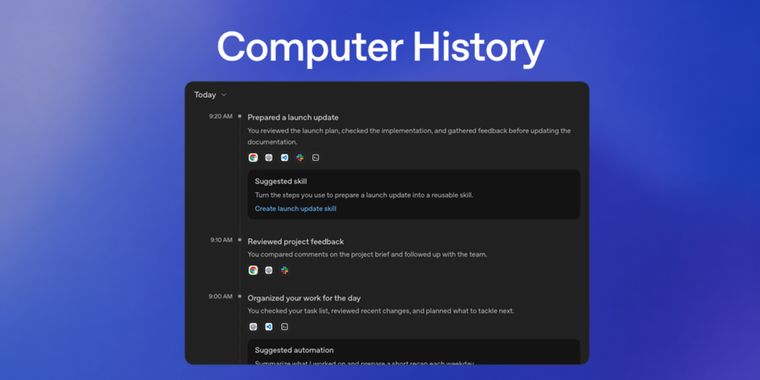

OpenAI launches a Computer History feature that tracks user activity across apps and sites
OpenAI has introduced Computer History in the ChatGPT desktop app for macOS, a new feature that enables the app to track user activity and interactions across applications and websites to give ChatGPT and Codex a running picture of what users have been doing on their devices and better predict what they may be looking for. The feature records interactions such as clicks, typing, keyboard shortcuts, and app switching through macOS accessibility APIs, then periodically turns that activity into text summaries organized in a timeline by day and time that can be used to resume previous tasks, locate recently accessed files, summarize work, or identify repeatable activities that could become skills.
The feature builds on ChatGPT Memories, but its approach inevitably brings to mind what we saw two years ago with Microsoft's Windows Recall, which also continuously logged user activity but faced major backlash after its 2024 announcement over the privacy and security implications of constantly recording PC activity. In this case, Computer History doesn't capture screenshots, microphone input, or system audio, but it still collects a detailed history of user interactions. The resulting local memory files can contain sensitive information and are not encrypted by Computer History itself, meaning other programs running under the same macOS user account may be able to access them.
It is also important to note that Computer History is opt-in and currently available to Pro, Business, and Enterprise subscribers on macOS, with access in the European Economic Area, Switzerland, and the United Kingdom coming later. OpenAI says the files are not used for model training and recommends excluding sensitive sources and protecting the Mac account. Users can choose which apps and websites are included, pause tracking, delete individual entries, or disable the feature entirely, while Business and Enterprise administrators can control whether employees are allowed to enable it.






Comments
OpenAI launches Total Surveillance. Between this and Meta's Pervert Glasses, we might as well live in the Matrix.
Sounds like a great way for OpenAI to gain training data for real-world examples of workflow. Didn’t Zuckerberg try to force this onto all Meta employees so his AI could learn to automate desktop tasks done by human employees?
If I worked for Meta I would train it to go automatically go to porn sites and download viruses.
I already do that and I don’t even work at Meta or train AIs!
There isnt enough data protection laws or any accountability whatsoever to selling and giving away data or incompetence in protecting it for anyone to want to trust such a feature by any company.
This is just as diabolical as Google and Microsoft. Quite surprising they mentioned what it does, but who knows what else it can capture without your knowledge. I don't even use OpenAI but this is really stupid whoever came up with this idea and tried normalizing it with the likes of Microsoft Copilot 🙄
Recall is a database that uses AI to categorize content of screen (and may send some few data to Microsoft, it must be a clause about it into the 28 pages of ToS). Even if Microsoft had great plans at that time to use another AI to make all kinds of recommendations, it's still a database.
Computer History feeds some context that is supposed to help AI to be more relevant, related to the OpenAI Operator failed experiment (where AI was able to randomly and very slowly control a computer), and could help reducing the number of prompts (but seems to greatly raise input tokens). User behavior is surely not used for training (because the data quality is not good enough), but may be for post-training.
Both are supposed to improve productivity, both are very laconic on how, and both can become privacy nightmares.
It's opt-in, so at least only stupid ones will use it.
No thanks. I'm in the middle of reclaiming my privacy. This is highly intrusive, and will be disastrous.