



CachyOS brings Easy Anti-Cheat v2 support, revamped package installer & new recovery tool
The Arch Linux-based distribution CachyOS has announced a new release headlined by support for Easy Anti-Cheat Linux v2, addressing one of the biggest remaining hurdles for gaming on Linux. Because EAC only allows games to launch when it can verify how the system was booted — requiring Secure Boot with a trusted kernel signature, TPM 2.0, an enabled IOMMU, and a lockdown-mode kernel that only loads signed modules — the distro now ships a dedicated kernel, linux-cachyos-eac, alongside a systemd-boot binary signed with the same key. The kernel gets its own boot entry while existing ones are preserved, so users only boot into it for EAC-protected games. A new eac-setup script handles configuration for systemd-boot, Limine and rEFInd, with experimental GRUB support, and eac-status verifies the result. Since DKMS modules won't work under the locked-down kernel, NVIDIA, ZFS and r8125 modules ship as pre-built linux-cachyos-eac-* packages instead.
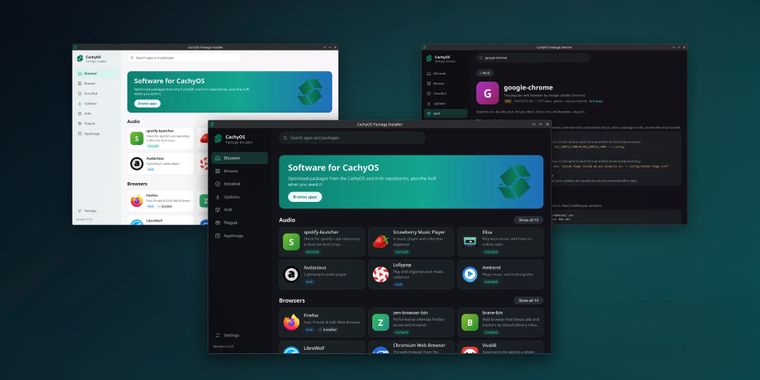
Gaming aside, the CachyOS package installer has received a full revamp in its 2.0 release, gaining a new interface and expanded capabilities. Beyond the CachyOS and Arch repositories, it can now build AUR packages — showing the PKGBUILD and install scripts for review before building, with static analysis highlighting lines worth inspecting — as well as install Flatpak apps and AppImages, all on an opt-in basis. AppImage support includes adding packages from local files or GitHub projects, with update tracking for GitHub-hosted releases. A new settings page offers color themes and a mirror-ranking button.
Rounding out the release, the introduction of cachyos-recovery means rolling back a broken system no longer requires a live USB. The self-contained recovery image, roughly 70 MB on the ESP, can be booted from the bootloader or directly from UEFI, letting users test any Btrfs snapshot with a writable root before permanently restoring it. Rollbacks regenerate the kernel, initramfs and bootloader configuration, signing them where Secure Boot with sbctl is in place, work independently of Snapper, and support LUKS-encrypted installations. The release also arrives with a broad set of under-the-hood changes: the new cachyos-drm-awaiter package replaces early KMS handling, the installer is gradually transitioning to the shared gucc backend, systemd-oomd is re-enabled by default, and the system ships with Linux 7.3.5 kernel, NVIDIA 620.73.04 and Mesa 26.3.1. A WSL image rounds out the new distribution targets.




- Linux Distro
- Free
- Open Source
Related news
External links
- CachyOS November 2026 ReleaseCachyOS • Official source
- CachyOS November 2026 Released With EAC Linux v2 Support, New Recovery ToolPhoronix
- CachyOS’s November release paves the way for playing EAC-covered games on LinuxXDA
- CachyOS Just Made One of Linux’s Biggest Gaming Problems Way EasierIt's FOSS
- CachyOS November 2026 ISO Release Brings CachyOS Package Installer 2.09to5Linux
- CachyOS November 2026 Release brings support for Easy Anti-Cheat Linux v2GamingOnLinux
No comments so far, maybe you want to be first?