Work rarely stays with one person from beginning to end. A requirement may move from a founder to a designer, from a designer to an engineer, from an engineer to a coding agent, and back to another person days later.
The difficult part is often not doing the individual task. It is keeping the thread intact through those handoffs: what are we trying to achieve, why does this task exist, where does it belong, what has already been decided, what changed and what happens next?
Teams often compensate by repeating the same context across tickets, documents and chats. Complex projects create another trade-off: put everything into one huge workspace and people have to sift through work that is irrelevant to them; split the work into lots of separate projects and spaces and the wider relationships become harder to follow.
WithNettle keeps the project itself as the source of truth.
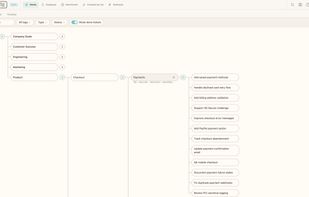
Projects, sub-projects, features and tickets can live in one connected structure and continue as deeply as the work requires. You can focus on any part of that structure without separating it from the project around it.
For example, a project to launch a new customer portal might contain a Website workstream. Website can contain Signup flow, and Signup flow can contain an individual ticket such as Fix invitation email. A designer may work from Website, an engineer from Signup flow, and an agent from the individual ticket. Each can focus on the level that matters to them while the ticket still knows where it belongs and why.
Break work down without breaking it apart.
Tree, Board and Timeline are different views of that same underlying work. Tree shows how the pieces relate, Board supports day-to-day delivery, and Timeline shows dated work and what is coming next. Changing the view does not create another plan or another copy of the project.
The project retains the information needed for the next handoff: its parent context, description, status, comments, decisions, attachments and progress. The next person can understand both what needs doing and why it belongs there.
The same principle extends to AI and coding agents. WithNettle can expose authorised project information through MCP so compatible clients can find the relevant project or ticket, read the surrounding context, create or update work, add comments and record progress.
Bug reported → agent picks it up → work completed → project updated.
The agent works from the same project information the team uses. When that session ends, the result and current state remain with the project for the next human or agent.
The AI session can end. The project does not.
For organisations, this means teams can concentrate on the area they own without turning every department or project into a silo. For individuals, it means keeping many substantial areas of work together without having to look at all of them at once. For teams using AI, it means the project—not the conversation—remains the durable source of truth.








 janeSaputra added WithNettle as alternative to JIRA, Trello, Asana and AFFiNE
 HeyZaney

