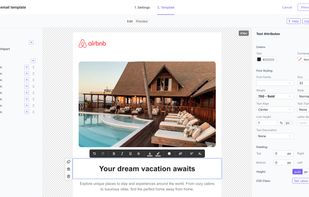
Notifuse is a self-hosted email platform that covers the whole stack in one app: contacts and lists, a drag-and-drop MJML editor, broadcast campaigns, visual automations, a transactional API, cookieless website analytics and a blog. It runs as a Docker image on PostgreSQL, with a setup wizard on first launch and a separate database per workspace, so tenants are isolated at the database level, not by a column in a shared table.
It does not send the email itself. You connect the provider you already pay for — Amazon SES, Postmark, SendGrid, Mailgun, Mailjet, SparkPost or any SMTP server — and Notifuse does the rest: open and click tracking, bounce and complaint handling, and a custom domain per workspace so tracked links, unsubscribe pages and the notification center sit on your own hostname. There is no per-email markup, because there is no delivery to resell.
Contacts carry 20 custom fields and a timeline of everything that happened to them: messages, opens, clicks, bounces, list changes, custom events from your own systems and, once a visitor is identified, the pages they read on your site. Segments are built on that timeline and recompute themselves, so you can target on RFM (lifetime spend, order count, recency), engagement, or browsing behaviour. Addresses that bounced or complained are suppressed at the database level and cannot be revived by a CSV import.
Broadcasts go to a list narrowed by a segment, with A/B tests that deploy the winner automatically on open or click rate, automatic UTM tagging, and data feeds that call your own HTTPS endpoint at send time — once per campaign or once per recipient — so live prices or stock render into the email. Automations are drawn on a canvas from trigger, delay, email, filter, A/B split, list and webhook nodes, and a sequence stops on its own when a contact replies. The transactional API upserts the contact, merges your payload with their stored profile and deduplicates on an external ID, so a retry never sends twice.
The web analytics are first-party and cookieless: sessions, pageviews and goals are written into your own database, with no cookie, no consent banner and no IP stored. Pages rank by TimeScore, the engaged time visitors actually spend, and a bounce is defined by that, not by page count. Traffic is classified by 40 editable attribution rules you can backfill over past data, and every broadcast annotates itself on the chart. Goals land on the contact timeline, which closes the loop back into segments and automations.
Also included: a notification center in ten languages, a blog with Liquid theming on your own domain, an S3-compatible file manager, outgoing webhooks, delivery logs with raw provider callbacks, template versioning, role-based permissions, scoped API keys, OIDC single sign-on, and an AI assistant running on your own Anthropic, OpenAI or Gemini key. Written in Go, licensed AGPL-3.0 and free to self-host, with a managed cloud available.



 EU
EU


 Notifuse


No comments or reviews, maybe you want to be first?