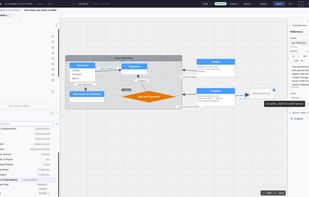
Inwardis keeps what you know about a system as a hierarchical model rather than separate diagrams. Every element can contain sub-elements, so a person or an AI agent opens one level, sees what matters there and drills into a single branch. Diagrams, documentation and exports are all generated from that one model and never maintained by hand. Built-in templates cover software architecture, data, processes and more, and you can define your own vocabulary in YAML.
The model stays linked to the code. A one-line mark in a source file ties it to the element that describes it, VS Code opens either one from the other, and you can see at a glance when the code has moved on since its description was last checked. The code says what the system does; the model keeps why, and it is still there after a month away or once the system has grown past what anyone can hold in their head.
AI agents are first-class clients. A built-in MCP server lets Claude, an IDE assistant or your own tooling read, search, create, relate, lay out and render the model. Agents work under the same rules as the canvas, so they can't write a model a person couldn't have drawn.
Every save is a git commit, with history, diffs, restore and push to your own remote. Notes are stored as Markdown files, so git diff and git blame work on the words. You can start from what you already have: UML models, C4 DSL files, API specs, database schemas, JSON samples and Jira projects. A VS Code extension mounts the model as folders and files.
Inwardis runs entirely on your own infrastructure with Docker, with no telemetry and no phone-home, not even for licensing. There's one licence with every feature included and unlimited users. The licence is perpetual: the subscription pays for new versions, and the version you have never stops working.






 EU
EU

 inwardis added Inwardis as alternative to Enterprise Architect, Visual Paradigm, IBM Rational Software Architect, Modelio and 17 more
 Inwardis


No comments or reviews, maybe you want to be first?