Filiation builds a research library from one paper, on your own computer.
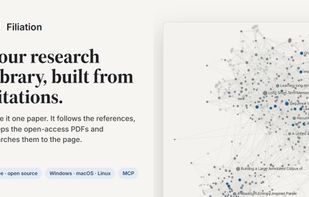
Give it a DOI, an arXiv ID, a link or a title. It follows the paper's reference list through OpenAlex, most-cited first and within a budget you set, and builds a map of what cites what: hundreds of related papers, each tied to the papers it cites.
It downloads the legal open-access PDFs of those papers (never paywalled ones), extracts their text, and makes them searchable. Type a few keywords and it finds the matching passages, names the page, and highlights them in the built-in PDF reader. Where the text allows, it also records the sentence in which one paper cites another, so you can trace where a claim came from.
AI assistants such as Claude, GitHub Copilot, Cursor and Gemini CLI can connect to your library over the Model Context Protocol (MCP). They then search the papers you actually have and quote passages with page numbers you can check, instead of inventing references.
Features:
- Start from a DOI, arXiv ID, PubMed ID, OpenAlex ID, link or title
- Citation map of a paper's neighbourhood, or of the whole library
- Find the chain of citations between two papers
- Topics found from the citations alone, offered as collections
- Full-text keyword search across your PDFs, results grouped by paper, with the page
- PDF reader with highlights, comments and several papers open in tabs
- Notes stay in your library; the PDF files are never changed
- Reads your Zotero library (read-only) and grows a citation map around it
- Import PDFs you already have; they are identified and filed
- Favourites, nested collections and coloured labels
- Export the citation graph as GraphML for Gephi or NetworkX
- Desktop app and a command-line tool (fil) that share the same library
- The Windows app installs without administrator rights and updates itself
Private by design: everything runs and is stored on your computer. No account, no subscription, no server. Bibliographic data comes from OpenAlex (CC0).
Honest limits: about 1 in 8 papers has a legal free PDF (far more in physics, far fewer in the humanities), and reference data is sparse outside the sciences.
Free and open source under the Apache-2.0 licence.






 Haren Daishika


No comments or reviews, maybe you want to be first?