EchoFog is an open-source peer-to-peer network that puts a VPN, an end-to-end encrypted messenger and group calls into one desktop app. There is no company server in the middle: exits are other users' computers and VPSes, relays are the participants themselves, and nodes find each other through a Kademlia DHT.
VPN. Pick an exit by ping, price, speed and which of your sites open through it, or let automatic mode keep testing exits and switch when one slows down. Route one app through a local SOCKS5 proxy, or the whole computer with a kill switch. Exits are free or paid per gigabyte in TON from the built-in wallet (testnet for now). Anyone can share their own connection, publicly or only with people who have an invitation link.
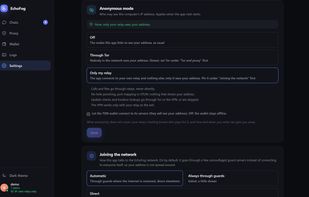
Camouflage. Across a border a connection looks like HTTP/3 to the website the node stands next to (QUIC-REALITY), with a TCP fallback that looks like HTTPS. Where the internet is censored, the app joins the network through a few camouflaged guard servers; anonymous mode hides your IP through Tor or your own relay.
Chats and spaces. Direct chats and groups run on a log of signed events kept by every member: replies, threads, reactions, pins and edits sync with nobody in the middle. A group can be a space with text channels, voice rooms, roles and per-channel permissions.
Calls and streaming. Group calls and screen sharing travel over relay trees built from the participants' own upload, end-to-end encrypted, with presets up to 4K60 and 1080p/1440p at 144 fps. On Windows the app captures and encodes the screen on the graphics card itself.
Your own node. A Docker image for amd64 and arm64 (ghcr.io/admiralcore/echofog-node), public or hidden behind invitation links.
Status: experimental, no independent security audit yet. Windows and Linux.
Screenshot credit: SuperTuxKart gameplay in the call screenshot by kimden STK, CC BY 3.0.












No comments or reviews, maybe you want to be first?