
ComIO.Studio icon
ComIO.Studio icon

ComIO.Studio

RS-232 and RS-485 serial terminal and serial port monitor for macOS, Windows, Linux, with a Modbus RTU decoder and RS-485 sniffer, time-stamped logging, macros, triggers and ESP32, STM32, AVR firmware flashing, plus optional Lua scripting, charts, an AI assistant (BYOK) and an MCP server.
ComIO.Studio screenshot 1

Cost / License

  • Freemium (Pay once or Subscription)
  • Proprietary

Application type

Platforms

  • Mac
  • Windows
  • Linux
0likes
0articles

Features

Properties

  1.  Lightweight
  2.  Support for Themes

Features

  1.  Ad-free
  2.  Support for scripting
  3.  Dark Mode
  4.  Syntax Highlighting
  5.  Serial terminal
  6.  Modbus
  7.  Serial-port
  8.  Lua scripting

ComIO.Studio News & Activities

Highlights All activities

Recent activities

ComIO.Studio information

  • Developed by

    PL flagComIO.Studio
  • Licensing

    Proprietary and Freemium product.
  • Pricing

    One time purchase that costs $99, and / or subscription ranging between $3 and $4 per month + free version with limited functionality.
  • Alternatives

    12 alternatives listed
  • Badge

    Get an embeddable badge for ComIO.Studio
  • Supported Languages

    • English
    • Arabic
    • German
    • Spanish
    • French
    • Hindi
    • Italian
    • Japanese
    • Korean
    • Polish
    • Portuguese
    • Russian
    • Turkish
    • Ukrainian
    • Chinese

AlternativeTo Category

OS & Utilities
ComIO.Studio was added to AlternativeTo by ComIO on and this page was last updated .
No comments or reviews, maybe you want to be first?

What is ComIO.Studio?

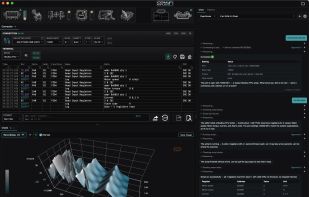
ComIO.Studio is a serial terminal and serial port monitor for Windows, macOS and Linux — an RS-232, RS-485 and UART terminal in one window. It talks to frequency inverters (VFDs), PLCs, servo drives, RS-485 sensors and energy meters, RS-232 instruments, and UART boards behind a USB to RS-485 or USB to serial converter.

Incoming data can be viewed as ASCII, HEX, a VT100 screen or decoded Modbus RTU frames, with time stamps and per-column filters. The decoder splits every frame into address, function, registers, values and CRC status; in Listen mode it pairs requests with responses on a bus it only taps into, which makes it an RS-485 sniffer and a Modbus sniffer. Vendor-specific function codes are recognised and can be given names.

Sending is done from one bar: text and hex in one view with a choice of line ending, or a Modbus RTU table that turns the app into a Modbus master for testing a device — the frame and its CRC are built from address, function and register fields. Commands can be repeated in a loop, sent from a file, kept as one-click macros, or answered automatically by triggers. The whole serial stream can be logged to a file as text, hex or both, time-stamped.

A built-in programmer flashes firmware to ESP8266, ESP32, STM32 and AVR boards over the serial port, without a separate tool. Control lines (DTR, RTS) are toggled from the toolbar; DSR, CTS, DCD and RI are shown live.

All of the above is free. An optional paid tier, ProBaud, adds Lua scripting with full access to the port — for automating test sequences, reacting to incoming frames and simulating a device, such as a Modbus slave answering a real master — measurement charts recorded by scripts, an AI assistant that uses the user's own AI provider account or a local model (bring your own key), and an MCP server that lets an outside AI agent such as Claude Code or Cursor use the serial tools under a permission gate.

The interface is available in 15 languages. The application is native, starts fast and has a small footprint.