SlideScope is one desktop viewer for scientific and medical images on Windows and macOS: microscopy, digital pathology whole-slide images and DICOM medical scans. It opens Zeiss CZI, ZVI and LSM, Nikon ND2, Leica LIF, LOF, XLEF and SCN, Olympus/Evident VSI, OIB and OIR, Imaris IMS, Aperio SVS and SVSLIDE, Hamamatsu NDPI, NDPIS, VMS and VMU, 3DHISTECH MIRAX MRXS, Ventana BIF, Vectra/PerkinElmer QPTIFF, Agilent ARGOS AVS, Philips iSyntax, KFBio KFB, DICOM, TIFF, OME-TIFF and OME-Zarr without a separate image server or conversion step. Whole-slide files are read through their existing image pyramid, so gigapixel scans open on an ordinary laptop. DICOM CT, MRI and X-ray series, including a hospital disc with a DICOMDIR, open for viewing and measurement.
Beyond viewing, it provides calibrated measurement in micrometres using the pixel size recorded by the scanner, annotations saved with the slide, metadata inspection, per-channel colour with brightness/contrast/gamma controls, and export of the current view or a selected region. Two slides can be opened side by side with synchronised panning and zoom matched by physical scale rather than zoom factor, which is the usual way to read an H&E section against an IHC restain.
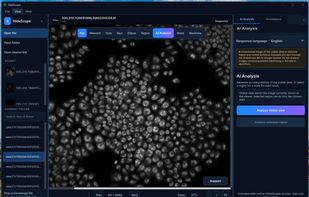
Local Quantification segments nuclei, cells or particles on the user's own machine and reports counts, density per square millimetre, morphology, per-channel mean intensity and marker positivity, with folder batch runs. Results export as CSV, GeoJSON and mask TIFF; GeoJSON coordinates are written at full slide resolution so regions open correctly in QuPath, ASAP and related Python tooling. A cloud-based AI Analysis feature describes the visible frame, and shared view links carry slide position, zoom and plane so a colleague opens the same field of view.
SlideScope is also published on the Microsoft Store and the Mac App Store. The download, the built-in sample library and a check of your own files (it shows, on your computer, whether each one opens and what you can do with it) are free. Opening your own images needs a subscription; there is no free trial. On the website, Individual is $29.99 per month or $299.99 per year and Individual Plus is $50 per month or $499.99 per year; students get 50% off. Labs and institutions are priced by quote. Current prices: https://slidescope.science/plans/
It is aimed at research labs, core facilities, educators and pathology review teams that need practical file review rather than scripted analysis pipelines, and at patients and students who need to open a CT or MRI disc on their own computer. Medical scans get no AI Analysis or quantification, and SlideScope is not for diagnosis. It does not do microscope control or custom scripted processing - ImageJ/Fiji, CellProfiler and QuPath remain the tools for that.








 Theodor-Waalberg added SlideScope as alternative to CellCount
 ynevet added SlideScope as alternative to ImageJ and Fiji


No comments or reviews, maybe you want to be first?