OrbitLan is an open-source virtual LAN application for Windows. It lets trusted friends connect their computers through a private network and use compatible LAN multiplayer games, direct-IP applications, development servers, and other local-network software across different internet connections.
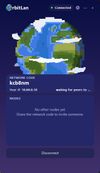
One person creates a room and shares a six-digit code. Everyone who joins receives a private 10.69.0.x address, allowing supported applications to communicate as though the computers were connected to the same local network. No OrbitLan account, email address, or permanent hosted profile is required.
OrbitLan attempts direct peer-to-peer connections first to reduce latency. Traffic between peers is encrypted with ChaCha20-Poly1305. If restrictive NAT or firewall conditions prevent a direct connection, an optional TURN relay can carry the encrypted traffic instead.
Unlike a conventional privacy VPN, OrbitLan does not route ordinary web browsing or change the user’s public location. It is specifically intended to provide a private virtual LAN between trusted devices.
Current features include:
Six-digit room codes with no account registration
Direct peer-to-peer connections when possible
Encrypted traffic between peers
Optional relay fallback for restrictive networks
Virtual 10.69.0.x addresses
Support for LAN broadcast and multicast traffic
Direct-IP connections for games where automatic discovery is unreliable
Room host controls for removing nodes
Notification-area mode for running alongside games
Configurable network-adapter priority
Portable and installed Windows packages
Self-hostable coordinator and relay support
MIT-licensed source code
OrbitLan currently supports 64-bit Windows 10 and Windows 11. Game compatibility varies, and direct-IP connection is usually the most dependable option when a game provides it.
Community Edition is free and can host rooms with up to four nodes. Supporter Edition is available as a one-time $5 purchase and can host larger rooms, provides a Force Relay troubleshooting option, and includes a separate visual theme. Both editions use the same networking and encryption core, and the complete source for both build flavors is publicly available.









No comments or reviews, maybe you want to be first?