KubeIntellect
An AI SRE for Kubernetes: connects to your cluster, investigates with real tools, explains the root cause in plain English, and executes the fix only after you approve it.
Cost / License
- Free
- Open Source (AGPL-3.0)
Platforms
- Linux
- Mac
- Windows
- Self-Hosted
- Docker
- Kubernetes
- Python
Features
- Command line interface
- Kubernetes
- Agentic AI
KubeIntellect News & Activities
Recent activities
- MSKazemi added KubeIntellect
MSKazemi added KubeIntellect as alternative to K9s, Radar k8s, Kubebar and Kubeli
KubeIntellect information
What is KubeIntellect?
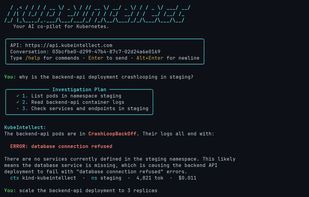
KubeIntellect is an open-source, LLM-orchestrated multi-agent framework for Kubernetes operations. You ask a question in plain English - for example "why is my api-server pod crashlooping?" - and it fans out to specialized agents that query kubectl, Prometheus (PromQL) and Loki (LogQL) against the live cluster, correlates the evidence, and answers with a root cause instead of a wall of logs.
It does not stop at read-only diagnosis. KubeIntellect can also change the cluster - scale, restart, delete - but never silently. Every mutating operation pauses and shows the exact kubectl command it proposes to run, and nothing executes until a human approves it. Access is gated by role-based access control with admin, operator and readonly roles, so a read-only user can investigate an incident without any ability to act on it.
Main capabilities:
- Natural-language root cause analysis correlating cluster state, metrics and logs
- A coordinator that delegates to dedicated pod, metrics, logs and events subagents
- A human-in-the-loop approval gate on every destructive action, backed by RBAC
- A terminal client (kq) plus a self-hostable HTTP API server
- Works against the observability stack you already run instead of replacing it
- An optional flight recorder that hash-chains each session so it can be replayed and verified
It is aimed at platform engineers, DevOps engineers, SREs and Kubernetes operators who want conversational troubleshooting with a hard safety gate on anything that changes the cluster.
Install paths include a pip-installable CLI, a pip-installable server, a Docker image and an in-cluster deployment, and there is a hosted read-only demo you can try in the browser. It requires Python 3.12 or newer and an OpenAI or Azure OpenAI API key.
KubeIntellect is released under the AGPL-3.0 license, and its architecture is peer-reviewed and published in the Journal of Grid Computing.