kern icon
kern icon

kern

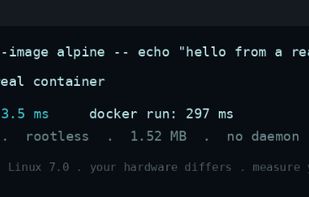
A fast, rootless sandbox and virtual resource runtime for any workload, including untrusted and AI-generated code. Daemonless: a real, kernel-enforced container in ~3.5 ms from an OCI image, no daemon, one 1.52 MB static binary.
kern screenshot 1

Cost / License

Application type

Platforms

  • Linux
  • Windows
  • Raspberry Pi
  • Rust
0likes
0comments
0articles

Features

  1.  Container Virtualization
  2.  Sandbox
  3.  Virtualization

kern News & Activities

Highlights All activities

Recent activities

  • BunkerVM icon
    POX added kern as alternative to BunkerVM
  • POX added kern

kern information

  • Developed by

    Unknown
  • Licensing

    Open Source (Apache-2.0) and Free product.
  • Written in

  • Alternatives

    1 alternatives listed
  • Supported Languages

    • English

AlternativeTo Categories

Network & AdminSystem & Hardware

GitHub repository

  •  218 Stars
  •  2 Forks
  •  0 Open Issues
  •   Updated  
View on GitHub

Popular alternatives

View all
kern was added to AlternativeTo by Paul on and this page was last updated .
No comments or reviews, maybe you want to be first?

What is kern?

A fast, rootless sandbox and virtual resource runtime for any workload, including untrusted and AI-generated code. A real, kernel-enforced container in ~3.5 ms, out of one 1.52 MB binary with no daemon.

What kern is:

One binary that manages resources, of which isolation is the first. That is why there is no single row for kern in a comparison table: it is a container runtime, a sandbox, a resource slicer and a stack runner at once, in 1.52 MB with no daemon.

  • A real container. Real OCI images: pull, build from a Dockerfile, commit, push, save/load. A box from an image starts in ~3.5 ms.
  • A sandbox, always rootless. User, PID, mount, network, UTS and IPC namespaces, an overlay or read-only root pivoted in, a deny-by-default seccomp allowlist and cgroup v2 limits. One flag, --security-profile untrusted, is the whole hardened bundle.
  • Resource profiles, not just isolation. CPU (vcpu:), memory, disk (vdisk:) and devices (vgpio:), declared once in a kern.toml and attached by name. kern run applies the same caps to a process on the host, with no sandbox at all, plus --landlock-rw <path> to confine that process's writes with the kernel's own LSM. docs/RESOURCES.md
  • Stacks, in kern's own format or in Docker's. kern compose <file> up takes a kern-compose.toml ([box.NAME] tables, with the resource profiles above) or the docker-compose.yml you already have, with no conversion step. One stack to one pod, services reaching each other by name.
  • The tools around them. ps, logs, exec, stats, inspect, wait, top (a live TUI), doctor, plus a Python and Node SDK and an MCP server for agents. The Python binding also plugs into LangChain twice: as a code tool, and as an execution policy for its shell middleware, where it is a peer of the Docker one. bindings/python/README.md

Its entire Rust dependency tree is libc: JSON and OCI manifests are parsed by hand, and pull shells out to the curl and tar already on the machine rather than linking a TLS stack. (1.52 MB is the size-optimized release build; a plain cargo install from source is 1.91 MB.)

Official Links