


Hoodik
32 likes
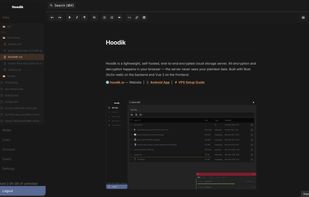
Lightweight, self-hosted encrypted cloud storage enabling fast uploads and downloads, easy Docker install, secure public link sharing, browser-side cryptography, searchable metadata, and low RAM footprint. Designed for privacy, performance, and file management.

Cost / License
- Free
- Open Source
Application typeApplication types
 EU
EUPlatforms
- Android
- iPhone
- Self-Hosted
- Docker


Features


Highlights All activities
Hoodik News & Activities
Recent News
No news, maybe you know any news worth sharing?
Share a News Tip
Recent activities
- Harvest Puffs liked Hoodik
 Anirban roy added Hoodik as alternative to ButterShare
- Croco Loki liked Hoodik
- Tina Shewmakers liked Hoodik
 diogohudson added Hoodik as alternative to ooshare.io


Developed by
 Tibor Hudik
 Licensing
Open Source and Free product.Written in
Alternatives
130 alternatives listedBadge
Get an embeddable badge for HoodikSupported Languages

AlternativeTo Categories
Security & Privacy, Backup & Sync, File Sharing, Office & Productivity, Development, Remote Work & Education, File ManagementApple AppStore
- Updated
- 0 avg rating
GitHub repository
- 1,522 Stars
- 72 Forks
- 18 Open Issues
- Updated




Selfhosting
Selfhosting is where you're hosting your own websites, apps, software, tools, and much more on your own server instead of having to rely on 3rd-party cloud providers such as Hetzner. Taking this approach to hosting gives you more control over your data and how your server or servers are managed.
When you are running multiple things on one or two servers, within your home, it's called a "Homelab" and you're "Homelabbing" at that point.
Running your own server and homelab within your home is great for privacy-conscious individuals such as myself, tech enthusiasts, small businesses, and those seeking more control of their digital life.
The following lists provided here are applications and software I've gotten comfortable with and enjoyed using over the past 3 and a half years since I started homelabbing, it's based on my experience and what fits my criteria. Some well known softwares won't be listed here, as my experience may of not been at best with them.
My criteria is that software is built in the open, respects user privacy and security, should not require a license to operate, and don't contain profanity and other minor things.
I'm also willing to test new software to selfhost, feel free to comment or message me to try out other alternatives.
There are other places to check out as well for those interesting selfhosting, such as Awesome Selfhosted, selfh.st, and other places you can find on the internet.
https://github.com/awesome-selfhosted/awesome-selfhosted
https://github.com/awesome-foss/awesome-sysadmin
https://github.com/veggiemonk/awesome-docker
If you ever need help with selfhosting, you can check out the following communities:
Homelab Community on Fluxer, I personally run
/r/selfhosted (Reddit)
/c/selfhosted (Lemmy / Fediverse)
There's also a wiki you can look into as well.
If you believe an alternative software should be added to this list, please contact me or direct message via my AlternativeTo account. I'm also available on Signal.
This lists gets updated every month at least, check back regularly.


Favorite Encryption solutions
Some countries are either implementing or planning to change laws that would enforce backdoor access to encryption provided by cloud services. Below are some decentralized encryption solutions that I recommend for both the present and the near future.


Self Hosted File Cloud
A list with 9 apps by 0ddL33 without a description.


No comments or reviews, maybe you want to be first?