Terminal emulators are built for text. Debugging a binary protocol needs framing, checksums, field decoding and byte-level visibility — which is what FrameTerm does.
Define the frame once — delimiter with escaping, fixed length, a length field (offset, size, endianness, adjustment) or a silent gap — and the incoming stream is split the same way no matter how it arrives. Feed it one byte at a time and you get identical frames.
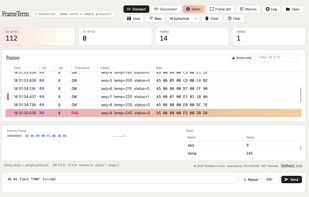
Every frame is checked against a fully parameterised CRC: width 8/16/32, polynomial, init, reflection and xorout, plus XOR8 and SUM8, with presets for CRC-16/MODBUS, CRC-16/CCITT-FALSE, CRC-32 and CRC-8. Each one is marked OK or FAIL, and every preset is verified against golden vectors from the public catalogue.
Declare fields by offset, type and endianness and a field table renders live for every frame. Highlight rules colour frames by byte pattern (with wildcards) or field condition. The send composer mixes hex and ASCII with placeholders computed at send time, for example A5 01 {len} "CMD" {crc16}, with twenty macros on the function keys.
The same pipeline runs over TCP as a client or a server, and auto-respond rules (pattern to composed reply, with optional delay) emulate a device well enough to automate a handshake. A whole session — port, framing, checksum, fields, highlights, macros — saves to a single .ftproj file.
Demo mode runs a sample protocol through an echo transport, so the entire feature set is explorable without hardware. Runs entirely offline; nothing is uploaded. Free and open source under the MIT License.







 Testbench.Tools


No comments or reviews, maybe you want to be first?