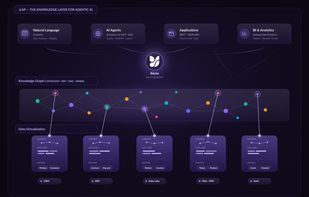
d.AP is the essential knowledge layer for enterprise AI. It addresses the disconnect between business data, which is scattered across various systems like CRM, ERP, support tools, data warehouses, and spreadsheets, and business logic, which resides in the minds of experienced employees. When AI is deployed, each copilot and agent starts from scratch. For instance, the SAP agent understands SAP, while the Salesforce agent understands CRM, but neither comprehends your business. This results in inconsistencies, conflicting figures, and untrustworthy responses.
d.AP rectifies this by transforming fragmented enterprise knowledge - facts, relationships, rules, and context - into a unified, machine-readable knowledge graph. This graph can be queried as a service by any AI system, application, or BI tool.
Here's how it works:
-
d.AP allows you to federate your data where it resides. Connectors for REST, JDBC, SOAP, Iceberg, and flat files integrate existing sources into the graph without requiring you to replace existing systems. You can choose between ETL caching or Zero-ETL real-time mapping per source, and adjust refresh and caching to balance cost and data freshness.
-
You can model your business in an ontology, defining the concepts, relationships, and constraints your organization uses. This includes terms like "Customer," "Subscription," "has contract," and "a contract must have an end date." You can start from included upper and supporting ontologies, then extend with domain-specific models without disrupting the core.
-
d.AP provides an operational workbench for governance. This includes versioning, governance, quality gates, and executable business logic. You can define a concept once and deploy it as a reusable, governed knowledge product across every system.
-
You can ask questions in plain language with Aluna, d.AP's AI agent. Aluna understands your ontology, not just keywords. It can convert questions like "Which customers are at risk of churn this quarter?" into real graph queries, which are executed live and returned in various formats.
-
Aluna ensures consistency, acting as a persistent grounding service for external agents and copilots. Applications consume REST/JSON, while analytics platforms pull aggregated data products as Iceberg tables.
-
d.AP also allows for transparency. Every answer exposes its source, filters, joins, and reasoning path. You can turn any insight into a dashboard widget linked to the logic behind it.
d.AP is built on open standards with guaranteed export and migration paths. Your business logic is not encoded in a proprietary semantic format and is not tied to any single LLM, cloud, or database vendor. Language models are hosted in Europe and are a modular, swappable component.







 EU
EU


 Mauricio B. Holguin added d.AP as alternative to Stardog Cloud, Timbr, Palantir Foundry, KGNN and 1 more
 digetiers


No comments or reviews, maybe you want to be first?