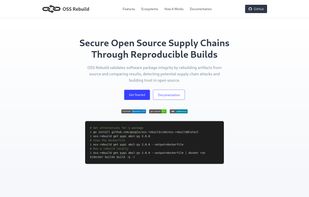
Securing open-source package ecosystems by originating, validating, and augmenting build attestations.
Cost / License
- Free
- Open Source (Apache-2.0)
Platforms
- Go (Programming Language)
- Linux
- Mac
- Windows
- BSD

Securing open-source package ecosystems by originating, validating, and augmenting build attestations.

Continuous Delivery Services for teams to share code, track work, and ship software – for any language, all in a single package.


Vulert notifies you if a SECURITY ISSUE is found in any of the open-source software you use. No installation needed.


FOSSA offers automated license scanning, dependency analysis and reports at each commit. Get a process up an running in 60 seconds, without slowing down development.
PackageFix is a free browser-based dependency security fixer. Paste your manifest file and get back a fixed version with every vulnerable package patched — ready to download in one click.


NeuVector Full Lifecycle Container Security Platform delivers the only cloud-native security with end-to-end protection from DevOps vulnerability protection to automated run-time security, and featuring a true Layer 7 container firewall.

sbomify is the trust center for your software supply chain. Store every SBOM and compliance document in one place, track them across products and releases, and share them with customers and regulators on demand. CycloneDX and SPDX, built for EU CRA compliance.


Founded in 2016 by cybersecurity industry veterans, Sepio’s HAC-1 is the first hardware access control platform that provides visibility, control, and mitigation to zero trust, insider threat, BYOD, IT, OT and IoT security programs.


HOL Guard is an open-source, local-first runtime security layer for AI agents and automation. It sits between any AI harness and the tools it wants to run, pausing risky package installs, secret reads, shell commands, and MCP changes for review before execution.


Generates SBOMs during CI from lockfiles, containers, and directories using native tooling with ecosystem coverage, metadata enrichment, trusted outputs, and OIDC publishing.

vet is a tool for protecting against open source software supply chain attacks. To adapt to organizational needs, it uses an opinionated policy expressed as Common Expressions Language and extensive package security metadata including: