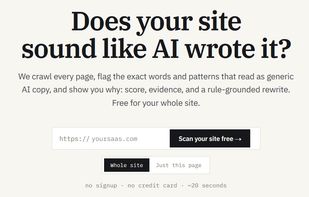
SiteTell scans your website and points out the sentences that read like they were written by AI. You enter a URL, it crawls your pages, and every flagged sentence comes back with the specific rule it broke. So instead of a single "87% AI" score you can't argue with or act on, you see the actual problems: a stock phrase that turns up on thousands of SaaS homepages, a run of sentences that are all the same length, or a closing line that doesn't say anything.
That's the main difference from detectors like Originality.ai or GPTZero. Those tools give you a probability and leave you to guess what's wrong. SiteTell shows its reasoning line by line, so you can decide for yourself whether a flag is fair. Sometimes it won't be. Technical copy can trip a rule for good reasons, and you're free to ignore it. Hemingway Editor is closer in spirit, but it's built for readability in general rather than the habits AI writing tools fall into.
It's aimed mainly at indie and solo SaaS founders who used ChatGPT, Claude or a landing page generator to get their marketing copy out the door, and now suspect it sounds a bit generic. Visitors pick up on that even when they can't say why. Marketing and SEO agencies also use it to check client and prospect sites.
The free scan needs no signup. You get an overall score, the score for your worst page (an average can hide one really bad page), and examples of what was flagged and why.
If you want help fixing things, a one-time payment of $20 per site unlocks suggested rewrites for each flagged sentence, plus exports as PDF, CSV or JSON. There's also a ready-made prompt you can paste into Claude Code or Cursor so your coding assistant can apply the edits for you. For sites that change often, an optional monthly plan re-scans automatically and emails you when new issues show up.
SiteTell isn't a "humaniser" and it isn't about catching anyone out. It's a copy check for your own site, much like running a spell checker before you publish.








 NotGeorge added SiteTell as alternative to Originality.AI, Grammarly, ZeroGPT.cc - AI Content Detector and GPTZero
 Rally Digital
