Scholar Sidekick is a fast, deterministic citation resolver, formatter, exporter, and verifier for researchers, clinicians, students, librarians, and AI agents.
Paste any scholarly identifier - DOI, PMID, PMCID, ISBN, ISSN, arXiv ID, ADS bibcode, or a WHO IRIS URL - and Scholar Sidekick fetches the bibliographic record from authoritative sources (Crossref, PubMed, arXiv, Open Library, ADS, DataCite), normalises the metadata, and renders a clean citation in your chosen style.
Five built-in styles - Vancouver, AMA, APA, IEEE, and CSE - are tuned for accuracy and speed. Beyond those, the full Citation Style Language (CSL) catalogue of 10,000+ styles is available, including journal-specific dependent styles that resolve to their parent style automatically.
Outputs travel anywhere your workflow needs:
• Plain text, HTML, and Markdown for direct paste
• RIS, BibTeX, CSL-JSON, and EndNote XML for reference managers (Zotero, Mendeley, EndNote, JabRef, Citavi)
• CSV for spreadsheets
Trust and integrity tools - purpose-built for the age of AI-generated text:
• Citation verifier - cross-checks the claimed title, author, and year against the paper at the resolved DOI/PMID/arXiv ID. Catches the dominant fabrication pattern (real identifier + invented title) that plain DOI resolution misses.
• Retraction checker - Crossref + Retraction Watch with status, reason, and date.
• Open-access checker - Unpaywall lookup surfaces the best legal free copy when one exists.
Scholar Sidekick exposes a public REST API with a documented OpenAPI spec, rate-limited tiers, and deterministic response headers (request ID, cache state, style provenance, fallback warnings).
It also ships across the surfaces researchers work in:
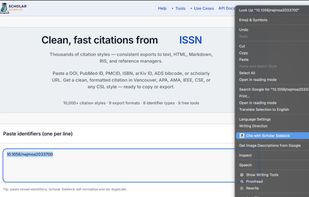
• Browser extensions for Chrome, Firefox, and Edge - right-click any selection to cite, check retraction, check open access, or verify; one toggle bundles retraction + OA into the cite flow.
• Obsidian plugin - replace an identifier at the cursor, insert from a searchable 10,000-style modal, export a whole note to BibTeX or RIS.
• Open-source Model Context Protocol (MCP) server - AI assistants like Claude and ChatGPT can resolve, format, export, verify, and check retraction/open-access status natively.
• Zotero plugin - verify citations before adding them to your library.
• Command-line client.
Engineered as boring, correct citation infrastructure: allowlisted outbound fetches, two-tier caching (in-memory LRU + persistent KV), SSRF protection, structured logs + Sentry, and 99% line / 99% branch test coverage in CI. Deployed on Vercel.
Use cases:
• Drop a DOI into a paper draft and get a perfectly formatted reference
• Bulk-export a PubMed reading list to RIS for Zotero
• Verify an AI-generated bibliography before submission, catching fabricated citations
• Screen a reference list for retracted papers
• Let an AI agent resolve, format, and verify citations via MCP
Free on the web, with paid API tiers for higher volume.








 Noskar added Scholar Sidekick as alternative to SafeRender
 samsergi added Scholar Sidekick as alternative to CitationEasy
 Ihsan Hossain added Scholar Sidekick as alternative to CitApp
 Scholar Sidekick added Scholar Sidekick as alternative to Cite This For Me, Zotero, JabRef, MyBib and 18 more


No comments or reviews, maybe you want to be first?