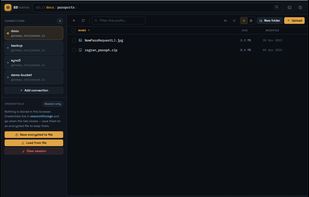
S3Feather is an S3 browser that runs entirely in your browser. It is one HTML file: open it, enter your access key, secret, and bucket, and start browsing. There is nothing to install, no build step, and no server component. The file talks directly to the storage endpoint from the page.
It works with AWS S3 and any S3-compatible provider, including MinIO, Cloudflare R2, Wasabi, DigitalOcean Spaces, Backblaze B2, and Storj. Path-style requests and Signature V4 are used automatically, so non-AWS endpoints need only a URL. The bucket must allow cross-origin requests.
Features include an editable s3:// address bar with breadcrumbs, a command palette, full keyboard navigation, multi-bucket connection switching, list and grid views with image thumbnails, sorting and filtering across every loaded page, presigned share links from five minutes to seven days, drag-and-drop upload with per-file progress, and recursive delete with progress you can stop. Prefixes larger than S3's 1,000-entry page load on demand. A flatten mode lists every key beneath the current prefix so you can search a whole subtree rather than walking it.
Selecting more than one object, or a prefix, downloads a single ZIP archive instead of a queue of separate downloads. Archives are built with a dependency-free ZIP64 writer and streamed straight to disk where the browser supports it, so a multi-gigabyte archive never buffers in memory.
Credentials are held only in sessionStorage for the tab, never in localStorage, cookies, or on disk. Connections can be saved to a passphrase-protected .s3vault file encrypted with AES-256-GCM using PBKDF2-HMAC-SHA256 at 310,000 iterations. Note that while you are connected the keys are in page memory, so anything running in the page can read them. Running the file locally and scoping credentials to a single bucket is recommended.






 EU
EU


 Aleksei Tertychnyi
No comments or reviews, maybe you want to be first?