Self-hosted serverless platform on Kubernetes and Knative, released as open source under the MIT license.
RunR is software you install, not a hosted service. The control plane comes as a Helm chart or as a Docker Compose stack for a single host (air-gapped hosts included); then you register any Kubernetes cluster as a region and RunR installs Knative Serving and the region components there.
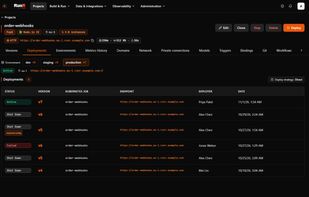
You deploy single-file functions written in the browser, multi-file projects with dependencies, any container image or WebAssembly modules, from the console, with git push, from the runr CLI, Terraform or a GitHub Action. Workloads scale to zero and back on request. Every code or configuration change is a version you can deploy, compare and roll back; projects have dev, staging and production environments, blue-green and canary rollouts, and can run in several regions behind one host name.
Triggers cover HTTP, schedules, queues, a webhook inbox, topics and brokers such as Kafka, NATS, RabbitMQ and MQTT. Each project type of a region runs under runc, gVisor or Kata Containers. Python, Node.js, Go, PHP, PyTorch and TensorFlow runtimes ship built in, and every language is a plugin. GPU workers, Hugging Face model services, a built-in MCP server and a Sandbox API for AI agents, durable workflows, managed Postgres, Redis and S3 bindings, RBAC, SSO (OpenID Connect, SAML), an audit log and an optional multi-tenant edition are included.








 runr added RunR as alternative to AWS Lambda, Google Cloud Run, Azure Functions, Vercel and 6 more




No comments or reviews, maybe you want to be first?