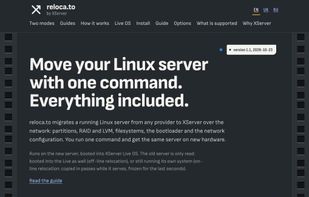
reloca.to migrates a running or offline Linux server from one machine to another over the network: partitions, md RAID, LVM, filesystems, bootloader and network configuration. Unlike disk imaging tools, it is not a byte-for-byte image and not a backup. It inventories both machines, writes a human-readable plan you can review and edit, lays out the new disks with the same UUIDs and filesystem features, copies every volume, fixes the copy up in a chroot (fstab, mdadm, initramfs drivers for the new controller, GRUB, network), verifies that it will boot, and only then cuts over. The old server is only ever read, so it remains your rollback.
The target hardware can differ from the source: software RAID to hardware RAID, larger to smaller disks, physical to virtual, and UEFI to BIOS or back.
Two modes:
- Off-line relocation: both machines boot a Live OS (via kexec, ISO or IPMI virtual media) and each volume is copied once at full disk and link speed.
- On-line relocation: the old server keeps serving users while a small agent copies volumes under load, tracking writes with eBPF or ftrace. Only changed blocks follow in further passes, and filesystems are frozen just for the final few seconds of delta.
Features:
- Dry-run mode that prints the plan and every command without changing anything
- Resumable phases (plan, apply, transfer, postfix, verify, cutover) that survive a dropped SSH session
- Compressed transfers (partclone, tar, lz4/zstd) over an encrypted channel with progress and ETA
- Dozens of pre-reboot checks; never reboots without a passing verify
- Never wipes a disk until you confirm its name and size
Supported sources: Debian 10-13, Ubuntu 18.04-26.04, CentOS 7-10, Rocky, AlmaLinux and RHEL 8-10; ext2/3/4, XFS, swap and ESP; ifupdown, netplan, systemd-networkd, ifcfg and NetworkManager.
Any machine booted from the reloca.to Live ISO can be the destination. The tool was written by the XServer team for its own data-centre migrations and for customers moving to XServer (whose servers can boot the Live OS straight from the control panel), and is released as free, MIT-licensed open-source software.






 EU


 Vitalii Ivanov added reloca.to as alternative to VMware vCenter Converter
 Vitalii Ivanov added reloca.to as alternative to Clonezilla, Rescuezilla, dd, Redo Rescue and 4 more


 XServer OÜ


No comments or reviews, maybe you want to be first?