PlaylistForge icon
PlaylistForge icon

PlaylistForge

Playlist Forge is a free, open-source desktop application that generates music playlists from a written description. The user enters a brief — for example, "late-night electronic soul for a rainy drive, warm bass, no festival drops" — and the app assembles an...
Playlist screen

Cost / License

  • Free
  • Open Source (MIT)

Application type

Platforms

  • Mac
  • Windows
  • Linux
0likes
0comments
0articles

Features

Properties

  1.  Lightweight
  2.  Privacy focused

Features

  1.  Ad-free
  2.  Personalized Recommendations
  3.  No registration required
  4.  Portable
  5.  Dark Mode
  6.  No Tracking
  7.  Create Playlist

PlaylistForge News & Activities

Highlights All activities

Recent activities

PlaylistForge information

AlternativeTo Category

Audio & Music

GitHub repository

  •  3 Stars
  •  0 Forks
  •  0 Open Issues
  •   Updated  
View on GitHub

Popular alternatives

View all
PlaylistForge was added to AlternativeTo by platten on and this page was last updated .
No comments or reviews, maybe you want to be first?

Official Links

What is PlaylistForge?

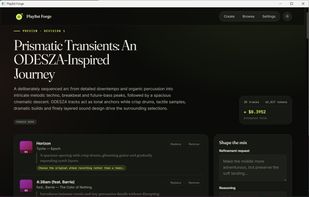
Playlist Forge is a free, open-source desktop application that generates music playlists from a written description. The user enters a brief — for example, "late-night electronic soul for a rainy drive, warm bass, no festival drops" — and the app assembles an intentionally ordered tracklist of real recordings, each with a short rationale and a note on the specific recording or version. It uses web search to check that the tracks and versions exist rather than inventing them.

Playlists are edited track by track: remove a track, replace a single track, or re-prompt the whole playlist to rework it. Every change is stored as an immutable revision. The app can also import existing TIDAL and Qobuz playlists (read-only) to browse, reuse as inspiration, or rework.

To move a finished playlist to a streaming service, Playlist Forge creates a temporary Soundiiz import link; Soundiiz performs the catalog matching and writes the playlist to TIDAL, Qobuz, Spotify, or Apple Music. Only track titles and artist names are shared.

It runs locally on Windows, macOS, and Linux with no account, no telemetry, and no server. It uses OpenAI's API, so the user supplies their own API key (kept in the operating system's credential store), and the app shows an estimated cost before each generation. Data is stored in a local SQLite file. Licensed under MIT.