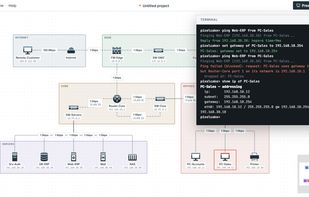
PixelCake is a network designer that runs entirely in the browser. You draw devices and cables, give them addresses, VLANs, static routes, firewall rules, NAT, DHCP and DNS, and then ask the network a question: does this PC reach that server? The packet is followed hop by hop on the drawing. When it does not arrive, it stops on the device that drops it, and the answer says why: the rule, the route, the VLAN or the port that is down.
A terminal with a small vendor-neutral command language edits the same drawing (for example: ping Web-ERP from PC-Sales), and a presentation mode lets you cut a cable or switch off a device and see which conversations stop and which take another path. Sample networks are included, from a small office to a 181-device, ten-site company.
No account and nothing to install; your work stays in your browser. Documentation in English and Italian. Open source under the AGPL-3.0.
Early version: it does not simulate frames (no ARP, no MAC tables), routing is static only, there is no spanning tree yet, and firewall rules know a few services rather than port numbers. It is meant for designing, explaining and documenting small networks, not for validating production ones.






 EU


 Phil-pje



No comments or reviews, maybe you want to be first?