

PikoCI
PikoCI is a self-hosted CI/CD system built around a resource/resource-type pipeline model, inspired by Concourse CI, but designed to run anywhere without operational pain.
Cost / License
- Free
- Open Source (Apache-2.0)
Platforms
- Self-Hosted
- Docker
Features
- Portable
- CI/CD
PikoCI information
What is PikoCI?
PikoCI is a self-hosted CI/CD system built around a resource/resource-type pipeline model, inspired by Concourse CI, but designed to run anywhere without operational pain.
Most CI/CD tools either lock you into a cloud platform or require spinning up multiple services just to get started. PikoCI runs as a single binary with pluggable database and queue backends. Use what you already have, or run entirely in memory with zero external dependencies. Bundle your binary, your pipelines, and your database file, and move them anywhere.
Pipelines are defined in HCL. The runner abstraction means you're not locked into a specific execution environment.
Features:
- Single binary: download and run. No Docker Compose, no Kubernetes, no setup scripts.
- Truly portable: bundle the binary with your pipeline config and SQLite file. Move it anywhere, run it instantly.
- In-memory mode: run the entire system in memory for development and testing. Zero files, zero cleanup.
- Any SQL database: SQLite (built-in), MySQL, PostgreSQL, and any other SQL-compatible backend.
- Any queue backend: pluggable via google/go-cloud, including NATS, Kafka, and RabbitMQ. AWS SQS and GCP Pub/Sub planned.
- Resource model: pipelines built from resources and resource types. Clean, composable, reusable.
- HCL pipelines: more expressive and readable than YAML. Familiar to anyone who has used Terraform.
- Flexible runners: run jobs on the host machine, in Docker containers, or define your own runner.
- Pipelines at startup: pass a pipeline config at launch and it's ready the moment the server starts. No CLI or UI step required.
- Public pipelines: mark a pipeline as public so anyone can view its status without an account. Perfect for open source projects.
- Built-in UI: visualize pipeline state, stream build logs, manage pipelines from a web interface.
- Teams and users: multi-user support with team-based access control. Granular role management planned.
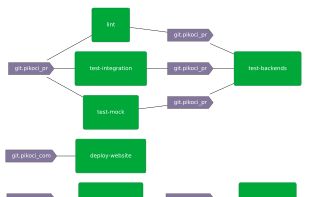
- DOT graph output: export pipeline state as a DOT graph, or as embeddable SVG/PNG images for READMEs and dashboards.