Cost / License
- Free
- Open Source (Apache-2.0)
Application typeApplication types
Platforms
- Self-Hosted
- Rust


Apps similar to OCaml include C (programming language), which is free and open source. Other options are Rust, C++, Haskell and Elixir. You're spoiled for choice with Programming Languages like OCaml: we list more than 25 alternatives for Linux, Mac, Windows, the web and self-hosting.

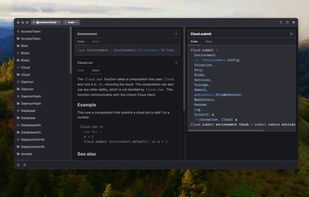
Unison is a statically-typed functional language with type inference, an effect system, and advanced tooling. It is based around a big idea of content-addressed code, in which function are identified by a hash of their implementation rather than by name, and code is stored as...


HolyC is very similar to regular C, so it's a very simple but powerful language. It was used to make all of TempleOS, so it definitely works to make programs.
 United States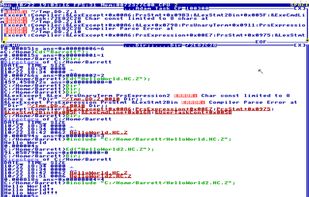


Elm aims to make web development more pleasant. Elm is a type-safe, functional reactive language that compiles to HTML, CSS, and JavaScript.


Wolfram Language is a symbolic language, deliberately designed with the breadth and unity needed to develop powerful programs quickly. By integrating high-level forms—like Image, GeoPolygon or Molecule—along with advanced superfunctions—such as ImageIdentify or...


Yon is an experimental, topos-oriented programming language: a compiled language whose semantics are drawn from category theory (elementary topoi, Heyting algebras, directed type theory) and whose runtime stores every value in a content-addressed heap built on the Leech lattice ?


Fortran (previously FORTRAN, derived from Formula Translating System) is a general-purpose, imperative programming language that is especially suited to numeric computation and scientific computing.

Object Pascal is a multi-paradigm, object-oriented, component-based general purpose programming language.

Mussel is an interpreted programming language written in Rust. It was designed as a simple and flexible language with a focus on easy-to-read syntax and powerful expression evaluation. Mussel supports basic data types, variable bindings, functions, closures, control flow...


Hare is a systems programming language designed to be simple, stable, and robust. Hare uses a static type system, manual memory management, and a minimal runtime. It is well-suited to writing operating systems, system tools, compilers, networking software, and other low-level...


Pike is a dynamic programming language with a syntax similar to Java and C. It is simple to learn, does not require long compilation passes and has powerful built-in data types allowing simple and really fast data manipulation.
 Sweden
 EU
EU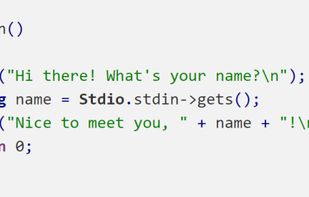


Nelua is a systems programming language for performance sensitive applications, like real-time applications and game engines. Its syntax and semantics are similar to Lua, but its garbage collection is optional, it provides optional type notations, and it is free from an...