Text letters can be converted into a series of dots and dashes, or short and long messages, using the Morse code technique. These signals can then be sent over great distances by radio waves, light, or sound. Samuel Morse and Alfred Vail created it in the early 1830s as a means of communication via telegraph systems.
Every letter of the alphabet and every number is represented in Morse code by a different combination of dots and dashes. The letter "A" is represented by ".-", the letter "B" by "-...", and the number "1" by ".----". You can send these sequences by beeping or toning repeatedly, tapping, or flashing a light. One of the primary benefits of Morse code is its ease of use and effectiveness, which makes it particularly helpful in scenarios where verbal communication is unreliable or impossible, such as amateur radio, emergency circumstances, and maritime communication.
Even though it is used less frequently than in the past, morse code is still utilized today, primarily by enthusiasts, in aviation, and for some emergency signaling applications. Morse code was originally created by Samuel Morse as an easy means to send messages across telegraph lines. Military forces popularized its use during WW1 and WW2 to communicate secret messages across telegraph wires or radio signals
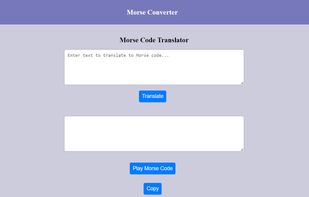
Features of Our Translator:
Automatically detects and translates Morse code or text.
Options to customize letter and word separators.
Transmit Morse code using your device's speaker.
Customize Morse code versions, transmission speed, tone frequency, and more.
Easily paste and copy translations, and share with other applications.








 onlinemorsecode added Morse Converter as alternative to Online Morse Code Translator

No comments or reviews, maybe you want to be first?