

Magika
Magika is a novel AI-powered file type detection tool that relies on the recent advance of deep learning to provide accurate detection. Under the hood, Magika employs a custom, highly optimized model that only weighs about a few MBs, and enables precise file identification...
Cost / License
- Free
- Open Source (Apache-2.0)
Platforms
- Mac
- Linux
- Python
- Rust
- JavaScript
- Homebrew
- Typescript
- Windows

Magika
Features
Properties
- Security-focused
- AI-Powered
Features
- Command line interface
- Python-based
- Python API
Magika News & Activities
Recent activities
Magika information
What is Magika?
Magika is a novel AI-powered file type detection tool that relies on the recent advance of deep learning to provide accurate detection. Under the hood, Magika employs a custom, highly optimized model that only weighs about a few MBs, and enables precise file identification within milliseconds, even when running on a single CPU. Magika has been trained and evaluated on a dataset of ~100M samples across 200+ content types (covering both binary and textual file formats), and it achieves an average ~99% accuracy on our test set.
Highlights:
- Available as a command line tool written in Rust, a Python API, and additional bindings for Rust, JavaScript/TypeScript (with an experimental npm package (which powers the web demo), and GoLang (WIP).
- Trained and evaluated on a dataset of ~100M files across 200+ content types.
- On our test set, Magika achieves ~99% average precision and recall, outperforming existing approaches — especially on textual content types.
- After the model is loaded (which is a one-off overhead), the inference time is about 5ms per file, even when run on a single CPU.
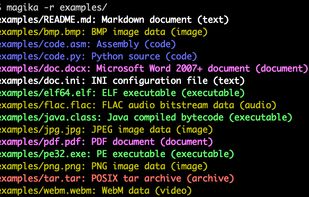
- You can invoke Magika with even thousands of files at the same time. You can also use -r for recursively scanning a directory.
- Near-constant inference time, independently from the file size; Magika only uses a limited subset of the file’s content.
- Magika uses a pre-tuned, per-content-type threshold system that determines whether to “trust” the prediction for the model, or whether to return a generic label, such as “Generic text document” or “Unknown binary data”.
- The tolerance to errors can be controlled via different prediction modes.
- Support for all major operating systems.
- The client and the bindings are already open source, and more is coming soon!