LinguaMiner is a local, Migaku-style flashcard miner for people who learn languages from the videos they already watch.
You open a video — a local file, a YouTube link or an HLS stream — and it plays with word-by-word clickable subtitles. Click a word you don't know and you get a popup with its lemma, part of speech, dictionary senses and how frequent it is. Keep it, and an Anki card is built for you: the sentence audio trimmed with ffmpeg, a short animated clip of that exact moment, the sentence with a neural translation, and the word itself.
Everything runs on your own machine. Transcription is Whisper, translation is CTranslate2 (OPUS-MT, or NLLB-200 for pairs OPUS doesn't cover), speech is Piper. No accounts, no subscriptions, no API keys, and nothing you watch is ever uploaded anywhere.
Twelve languages: Catalan, French, English, German, European Portuguese, Italian, Dutch, Russian, Mandarin Chinese, Cantonese, Japanese and Korean — translating into Spanish or English.
Other things it does:
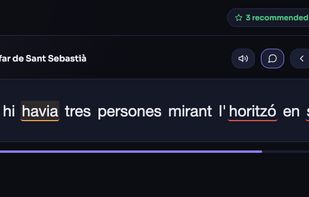
• Migaku-style word states — red for new, orange for learning, unmarked for known — synced from your actual Anki review intervals, with a chip showing what percentage of the video you already understand.
• i+1 recommendations: a word is highlighted only when it's unknown, frequent enough to be worth learning, and not a proper noun.
• Imports the vocabulary you already have from Migaku, jpdb, LingQ or an Anki deck, so those words don't start out red.
• Reads books too — import a .txt or .epub and you get a LingQ-style reader with the same clickable words, sentence mode, and cards read aloud by Piper.
• Condensed audio: export an MP3 with only the dialogue of an episode (a 50-minute show becomes about 20) for passive listening.
• Podcasts and radio work as sessions, not just video.
• Import your own dictionaries, including Yomitan format.
Free and open source under the MIT license. Runs on Windows, macOS and Linux.







 thecopybookhare-cmd added LinguaMiner as alternative to Language Reactor, NflxMultiSubs, Youtube Bilingual Subtitles and Streal
 thecopybookhare-cmd

