LibrePing icon
LibrePing icon

LibrePing

Open-source, decentralized uptime and status monitoring that checks your services from many locations worldwide, with no central server.
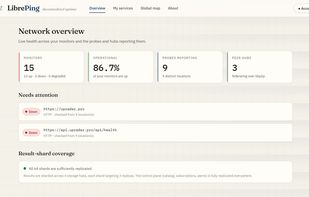
LibrePing screenshot 1

Cost / License

Platforms

  • Online
  • Self-Hosted
  • Docker
0likes
0comments
0articles

Features

Properties

  1.  Decentralized
  2.  Privacy focused

Features

  1.  No Tracking
  2.  Ad-free
  3.  Website Monitoring
  4.  No registration required
  5.  Server Monitoring
  6.  Uptime Monitoring
  7.  Peer-To-Peer
  8.  Status Page

LibrePing News & Activities

Highlights All activities

Recent activities

LibrePing information

  • Developed by

    mwgg
  • Licensing

    Open Source (AGPL-3.0) and Free product.
  • Written in

  • Alternatives

    9 alternatives listed
  • Supported Languages

    • English

AlternativeTo Categories

Network & AdminFile Sharing

GitHub repository

  •  7 Stars
  •  2 Forks
  •  0 Open Issues
  •   Updated  
View on GitHub
LibrePing was added to AlternativeTo by mwgg on and this page was last updated .
No comments or reviews, maybe you want to be first?

What is LibrePing?

LibrePing is a decentralized, peer-to-peer uptime monitor. It checks whether websites and services are online from many places around the world at once and shows the results on a live geographic map. Unlike commercial monitoring services, there is no central company and no single server: anyone can run a node, and nodes share their signed measurements with each other directly over a libp2p gossip mesh.

There are two roles you can run. A Hub is a publicly reachable node that stores results, serves a dashboard, and federates with peer hubs. A Probe is a lightweight agent that runs checks from its location and submits signed results to a hub. You can also just use it with no hosting at all: open any public hub's dashboard, and a browser-held key becomes your account — no signup.

Features:

  • Multi-location checks: HTTP(S), TCP, DNS, TLS certificate, ICMP ping, and traceroute, run from probes around the world.
  • Truly decentralized: hubs form a peer-to-peer mesh with no central server; results, the check catalog, and the hub directory federate and converge via gossip, anti-entropy, and catch-up sync.
  • No signup: the dashboard creates a key in your browser that is your account.
  • Deduplicated by design: the same target added by many people is one shared check, monitored once.
  • Everything is signed and verified: every result, check, subscription, and hub announcement carries a signature that every hub checks; forged or tampered data is dropped on arrival.
  • Encrypted alerts: get notified via ntfy, Discord, Slack, or a raw webhook when a service is down, confirmed from multiple locations. Your destination is sealed so only the hubs that actually notify you can read it. Delivery is at-least-once with automatic hub failover.
  • Live geographic dashboard: a world map, a network overview, and a per-monitor view with uptime/latency timeline and per-location breakdown.
  • Scales with the network: results are sharded across hubs rather than every hub mirroring everything.

Official Links