

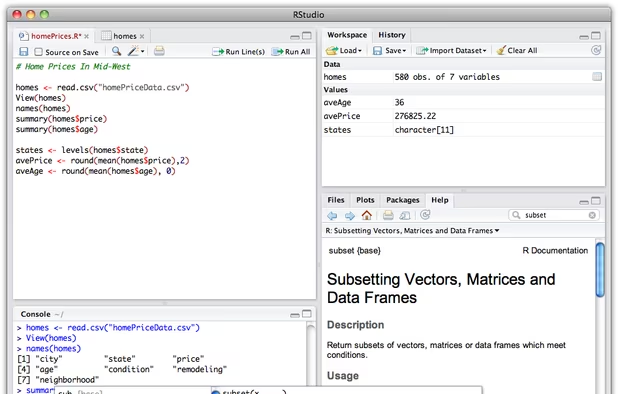
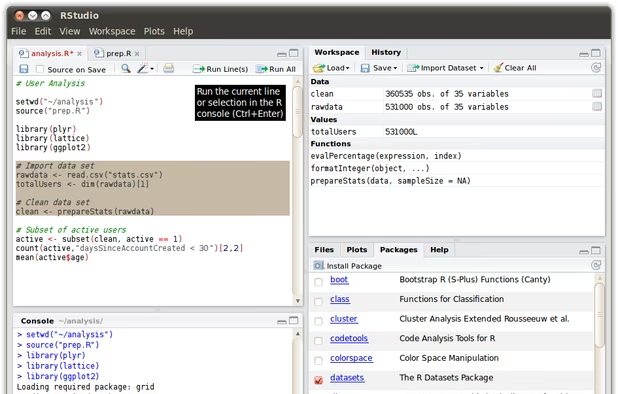
RStudio™ is an integrated development environment (IDE) for R. RStudio combines an intuitive user interface with powerful coding tools to help you get the most out of R.
 United States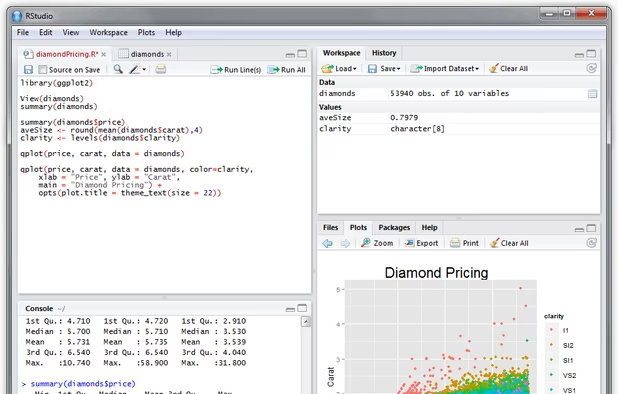
+1


Jupyter is described as 'The Jupyter Notebook is a web application that allows you to create and share documents that contain live code, equations, visualizations and explanatory text. Uses include: data cleaning and transformation, numerical simulation, statistical modeling, machine learning and much' and is a popular jupyter notebook in the development category. There are more than 50 alternatives to Jupyter for a variety of platforms, including Web-based, Windows, Linux, Mac and Self-Hosted apps. The best Jupyter alternative is RStudio, which is both free and Open Source. Other great apps like Jupyter are Mathematica, GNU Octave, SageMath and Spyder.
RStudio™ is an integrated development environment (IDE) for R. RStudio combines an intuitive user interface with powerful coding tools to help you get the most out of R.

Definitive technical computing system spanning machine learning and neural networks, data science, visualizations and much more.


Octave is a computer program for performing numerical computations which is mostly compatible with MATLAB . It is part of the GNU Project. It is free software under the terms of the GNU General Public License.


For people coing from Matlab, Octave is a good alternative for free, with of course less toolboxes, but for free


SageMath is a free open-source mathematics software system licensed under the GPL. It builds on top of many existing open-source packages: NumPy, SciPy, matplotlib, Sympy, Maxima, GAP, FLINT, R and many more.


Combines advanced editing, analysis, debugging, and profiling functionalities with data exploration, execution, and visualization capabilities. Expandable using its powerful plugin system and API, providing flexibility for custom integrations.


IPython offers a robust architecture for interactive computing, including dynamic shells, a kernel for Jupyter, interactive visualization, GUI toolkit support, and seamless project embeddings. Targeting high efficiency in parallel computing, it supports Python interactions tailored for Jupyter environments.


An extensible environment for interactive and reproducible computing, based on the Jupyter Notebook and Architecture. Currently ready for users.


A powerful IDE for data science, Zasper excels with massive concurrency support, enabling numerous simultaneous connections, minimal memory usage, and speedy performance. Suited for REPL-style data apps like Jupyter notebooks, fully supported on Mac with limited Linux support.


Scilab is free and open source software for numerical computation providing a powerful computing environment for engineering and scientific applications. Scilab includes hundreds of mathematical functions.


nteract is a desktop application that allows you to develop rich documents that contain prose, executable code (in almost any language!), and images. nteract helps you write your next code-driven story.


nteract is an Electron-based, cross-platform desktop application that uses Jupyter kernels but gives you a richer interface and OS native file-associations, etc.
It's almost the same (as jupyter) but has very lightweight app for mac, so i don't have to start any kind of server
Uses node.js out of the box and supports python


Colaboratory is a free Jupyter notebook environment that requires no setup and runs entirely in the cloud. With Colaboratory you can write and execute code, save and share your analyses, and access powerful computing resources, all for free from your browser.


Livebook is a web application for writing interactive and collaborative code notebooks. Code notebooks with Markdown support and Code cells where Elixir code is evaluated on demand.


 Germany
 EU
EU


 France

 Brazil
Octave is not a notebook environment but a programming language.