
JPEG Audit icon
JPEG Audit icon

JPEG Audit

JPEG Audit is a free online tool that analyses a JPEG photo and reports what the file says about itself — and where it contradicts itself.
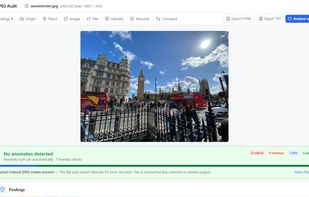
One photo, one audit document: the anomaly verdict first, then the photo and
collapsible chapters for origin, place, image, structure, identity, records
and comparison.

Cost / License

  • Free
  • Proprietary

Application type

Platforms

  • Online
0likes
0comments
0articles

Features

Properties

  1.  Privacy focused

Features

  1.  Ad-free
  2.  No registration required
  3.  No Tracking
  4.  Built-in viewer
  5.  Metadata Editor
  6.  Remove metadata

JPEG Audit News & Activities

Highlights All activities

Recent activities

JPEG Audit information

  • Developed by

    CZ flagGrata Luma, s.r.o.
  • Licensing

    Proprietary and Free product.
  • Alternatives

    10 alternatives listed
  • Supported Languages

    • English
JPEG Audit was added to AlternativeTo by RobBon on and this page was last updated .
No comments or reviews, maybe you want to be first?

What is JPEG Audit?

It reads EXIF, IPTC and XMP metadata including GPS, decodes the JPEG structure (markers, quantization and Huffman tables, chroma subsampling) down to a hex view, computes a perceptual hash and SHA-256, and compares two files field by field. On top of that it runs automated forensic checks and returns a severity-rated verdict: timestamp inconsistencies across EXIF and GPS, editing-software fingerprints, embedded thumbnail versus main image mismatch, data appended after the end of the image, and quantization tables untypical for camera output. When a photo carries a GPS bearing, it puts the picture side by side with a Google Street View panorama at those coordinates, turned to the same heading — the location check OSINT researchers otherwise do by hand. Metadata can also be edited or removed losslessly: values are written in place and whole segments dropped, so the image data is copied bit-for-bit with no re-compression. No account, no limits, no ads. Photos are processed in memory and never stored.