


GNU Emacs
387 likes
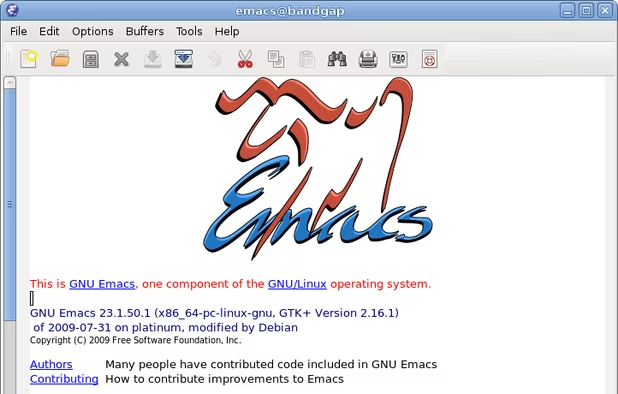
GNU Emacs is an extensible, customizable text editor—and more. At its core is an interpreter for Emacs Lisp, a dialect of the Lisp programming language with extensions to support text editing. The features of GNU Emacs include:
Cost / License
- Free
- Open Source (GPL-3.0)
Application types
Platforms
- Mac
- Windows
- Linux
- Android
- BSD
- Snapcraft
- F-Droid
- Haiku
- Debian
- MacPorts
- Homebrew

Features
Properties
- Customizable
- Privacy focused
- Lightweight
- Support for Themes
- Distraction-free
Features
- Extensibility
- Org-mode
- Extensible by Plugins/Extensions
- Self-documenting
- Multi OS
- Terminal-based
- Package Control
- Editable text color schemes
- Syntax Highlighting
- IDE All Languages
- Code Completion
- Support for scripting
- No Tracking
- Command line interface
- Portable
- Code Formatting
 Git Support
- Dark Mode
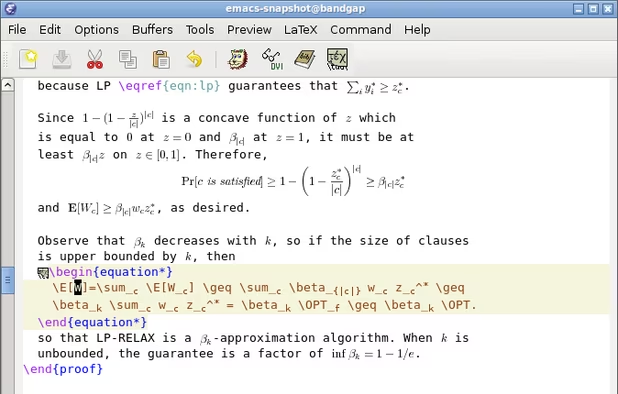
 Support for LaTeX
- Autocompletion
- Support for MarkDown
- Works Offline
- Spell Checking
- Ad-free
- No registration required
- Batch Editing
- No Coding Required
- Live Preview
- Full-Text Search
- File Versioning
- Batch Rename Files
- File Tagging
- Email Organizer
- Hierarchical Structure
- Lisp-like
- Gtk
- Package Manager
GNU Emacs News & Activities
Highlights All activities
Recent News
No news, maybe you know any news worth sharing?
Share a News TipRecent activities
- kdsfoiukvmko liked GNU Emacs
 Chloe_Builds added GNU Emacs as alternative to Soma AI Notes
 OrdinaryPerson added GNU Emacs as alternative to Visual Code Space
 Ugotsta added GNU Emacs as alternative to Fresh editor


Featured in Lists

Must have
List by Faradeus with 71 apps, updated

This is going to be a list of the free tools/software that can be used mostly in any field. it's based on websites …
List by tameresa with 138 apps, updated
How are you? In this list I bring you a variety of alternative software to those from Microsoft, and also that these …
List by AxelFOSS with 140 apps, updated
What is GNU Emacs?
GNU Emacs is an extensible, customizable text editor—and more. At its core is an interpreter for Emacs Lisp, a dialect of the Lisp programming language with extensions to support text editing. The features of GNU Emacs include:
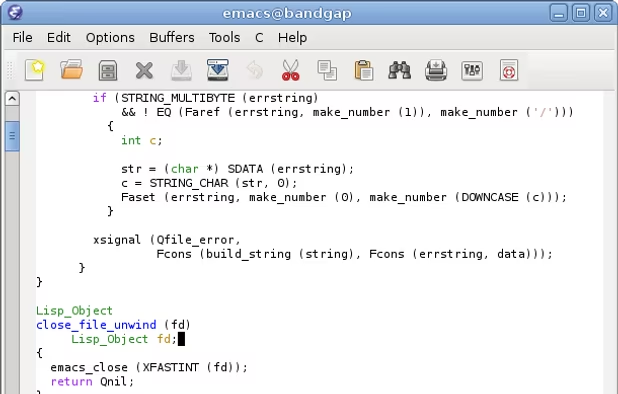
- Content-sensitive editing modes, including syntax coloring, for a variety of file types including plain text, source code, and HTML.
- Complete built-in documentation, including a tutorial for new users.
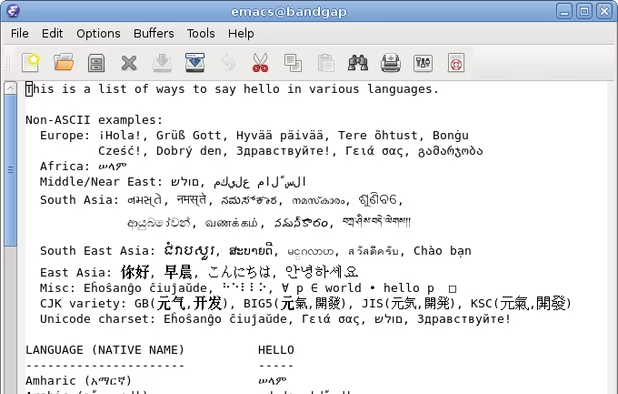
- Full Unicode support for nearly all human languages and their scripts.
- Highly customizable, using Emacs Lisp code or a graphical interface.
- A large number of extensions that add other functionality, including a project planner, mail and news reader, debugger interface, calendar, and more. Many of these extensions are distributed with GNU Emacs; others are available separately.
GNU Emacs information
Developed by
 Free Software Foundation
 Licensing
Open Source (GPL-3.0) and Free product.Rating
Average rating of 4.3Alternatives
184 alternatives listedSupported Languages
- English


Comments and Reviews
It would be more appropriate to compare Emacs to an operating system than to a text editor, and I mean that in a good way. Once you manage to grok Emacs, you'll seldom want to be anywhere else.
Could be the world's first super app.
Emacs is not just a text editor or an IDE, it's a whole text based operating system. Emacs is what I hoped command shells would be before I started to learn them. The learning curve is nightmarish, but it's worth it.
Was the hackable editor long before Atom and VSCode came to be. Pretty lightweight too.
Many say it's learning curve is pretty steep but nowadays it is pretty easy to get started with thanks to starter kits like Doom Emacs.
You can simply make your own config too, pretty easy to do thanks to thousands of community-made packages and third party documentation (e.g. EmacsWiki)
Emacs is built around being a Elisp interpreter with a text editor. You can do a lot with it, and has amazing packages and distributions for a lot of different use-cases.
The most problematic things with GNU Emacs are performance, bugs, and package integration. Emacs is an ancient piece of software, i.e. no multi-threading, and elisp is not that performant either. There are some hope for better performance with Gccemacs (i'm actively using it) which natively compiles elisp, noticeable making Emacs snappier mainly with GUI elements. Still, as of November 2020, it has a lot of bugs, is unstable, and it doesn't solve performance issues for a good enough experience. When using a lot of packages, and the fact i'm using unstable pgtk-native-comp, it crashes a lot. And the packages integration thing is that packages are built by users and may not be made with performance in mind, and can conflict with other packages etc so you have to tweak them. Also Emacs packages are a nightmare security risk btw.
[Edited by Lunatica, November 20]
After two decades of using vi simply because it was there, I decided to take the plunge and try Emacs. I find interface is nicer, and after a few hours of tweaking settings I've found a configuration that looks good and functions well on Windows, Linux, and FreeBSD.
I really like that Emacs comes with a bunch of utilities built in, such as the wonderful Org mode.
On Windows, Emacs has replaced Evernote and OneNote for note taking (with org mode) and Notepad++ and EditPad Pro for text editing.
A simply wonderful old-school productivity tool. Thank-you Richard Stallman and Guy Steele, Jr.
There's no limits for Emacs. You really should try, if you can! ;)