
Ghost Vessel icon
Ghost Vessel icon

Ghost Vessel

A monitor-resident avatar that acts as the front-end for a local LLM agent, performing its replies instead of printing them.
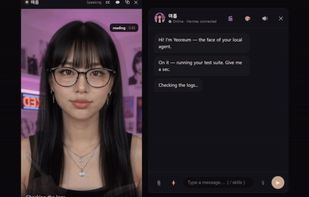
Ghost Vessel screenshot 1

Cost / License

  • Free
  • Open Source (MIT)

Application type

Platforms

  • Windows
  • Self-Hosted
2likes
0comments
0articles

Features

Properties

  1.  Privacy focused
  2.  AI-Powered

Features

  1.  No Tracking
  2.  No registration required
  3.  AI Chatbot

Ghost Vessel News & Activities

Highlights All activities

Recent activities

Ghost Vessel information

  • Developed by

    Ghost Vessel
  • Licensing

    Open Source (MIT) and Free product.
  • Written in

  • Alternatives

    4 alternatives listed
  • Supported Languages

    • English

AlternativeTo Category

AI Tools & Services

GitHub repository

  •  17 Stars
  •  1 Forks
  •  0 Open Issues
  •   Updated  
View on GitHub
Ghost Vessel was added to AlternativeTo by ghdtjrtka on and this page was last updated .
No comments or reviews, maybe you want to be first?

What is Ghost Vessel?

Ghost Vessel is a desktop client for a local LLM agent that happens to have a face. Instead of keeping a messenger tab open to talk to your agent, you get two small always-on-top windows — an avatar and a chat pane — and the agent's replies are performed rather than printed.

The reply is split into three planes: dialogue is spoken through local TTS, data (code, logs, file paths) is rendered as cards and never read aloud, and action is carried by inline emotion-beat tags the model emits in-band. A [working] tag has the avatar put on glasses and take notes while a task runs; [confirm] pops an approve/cancel that blocks the agent until you answer.

The avatar runs no live inference. Roughly 30 pre-rendered clips are selected and blended by those tags, so the GPU stays available for the language model itself. The trade-off is that there is no real-time lip-sync.

It does not replace your agent. It registers as a connector — the agent's gateway dials out to a local WebSocket the app hosts, so from the agent's side it is simply another channel. Adapters for Hermes and OpenClaw are included, along with a demo mode that needs no agent at all. The agent's own slash-command menu is served in the chat pane.

Voice works in both directions: Edge TTS by default, swappable for local engines (Qwen3-TTS, MeloTTS, Piper), with Silero VAD and faster-whisper for input.

The engine is MIT-licensed and ships with a free starter avatar, so cloning the repository gives you something that runs immediately. Avatars are pure-data bundles — clips, persona, theme, voice and emotion map, with no code — so any art style works: photoreal, 2D, 3D, or a pre-rendered Live2D/VRM model. Currently Windows-only.