

FlashTester icon
FlashTester icon

FlashTester

 Like

FlashTester checks whether a USB stick, SD card or other disk really stores what its label says. It fills the drive with test data and reads it back, the same way h2testw does, and it can re-check the .h2w files h2testw leaves behind.
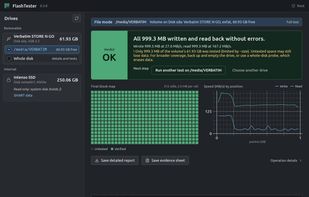
Result of a full test: verdict, block map and speed graph

Cost / License

  • Free
  • Open Source (MIT)

Application type

Since

  • New

GitHub

  • GitHub stars: 78

Platforms

  • Windows  Windows 10 or 11, x64
  • Linux  x86_64 and ARM64 static binaries. The GUI needs X11 or XWayland.
  • BSD
  • FreeBSD  amd64, FreeBSD 13.5 or later. The GUI needs X11.
  • Haiku
0likes
0articles
Save

Features

Features

Highlights All activities

FlashTester News & Activities

Recent activities

FlashTester information

AlternativeTo Category

OS & Utilities

GitHub repository

  •  78 Stars
  •  5 Forks
  •  4 Open Issues
  •   Updated  
View on GitHub

Popular alternatives

View all
FlashTester was added to AlternativeTo by Dissimilis on and this page was last updated .

No comments or reviews, maybe you want to be first?

Official Links

What is FlashTester?

FlashTester checks whether a USB stick, SD card or other disk really stores what its label says. It fills the drive with test data and reads it back, the same way h2testw does, and it can re-check the .h2w files h2testw leaves behind.

A quick probe finds a fake drive's real capacity in minutes. Quick diagnostics takes 3 to 15 minutes on a whole disk and reports capacity samples, write-cache size and speed. Both erase the drive. The full test can also run on free space only, though on a fake drive those writes may land on existing files.

It also measures sequential and random 4K speed, reads drive identity and SMART counters, scans for unreadable areas, and backs up files to ZIP or a whole disk to an image. Results are saved as HTML or JSON, with a one-page evidence sheet for refund claims.

One file per platform, no installer. GUI and command line on Windows, Linux (x64 and ARM64) and FreeBSD, plus an experimental command-line build for Haiku. Disks the running system uses can be read but never written. MIT licence, written in Rust.