drip by Beau Sterling icon

drip by Beau Sterling

A free, open-source CLI that shows how much water your AI coding agent (Claude Code, Codex) uses.
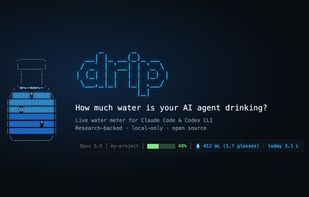
How much water your AI coding agent uses, measured locally from session logs

Cost / License

  • Free
  • Open Source (MIT)

Platforms

  • Mac
  • Linux
  • Python
  • Terminal
0likes
0articles
Save

Features

Properties

  1.  Privacy focused
  2.  Lightweight

Features

  1.  Command line interface
  2.  No Tracking
  3.  Ad-free
  4.  Works Offline
  5.  No registration required
  6.  Sustainability

drip by Beau Sterling News & Activities

Highlights All activities

Recent activities

drip by Beau Sterling information

AlternativeTo Categories

OS & Utilities, Development, AI Tools & Services

GitHub repository

  •  1 Stars
  •  0 Forks
  •  0 Open Issues
  •   Updated  
View on GitHub
drip by Beau Sterling was added to AlternativeTo by Beau Sterling on and this page was last updated .

No comments or reviews, maybe you want to be first?

Official Links

What is drip by Beau Sterling?

Your AI coding agent uses water. drip shows you how much.

drip is a small open-source command-line tool for developers who use Claude Code or Codex CLI. It reads the session logs those agents already write on your machine, counts input, output and cache tokens exactly, and converts them into an estimate of the water used to serve them: cooling water at the data center plus the water used to generate its electricity.

You see it three ways: a live water-drop segment in the Claude Code status line, a split-pane meter next to Codex or any other agent (drip run codex), and a browser breakdown with per-model numbers, an uncertainty range, 30-day history and a share card.

The coefficients come from peer-reviewed and government sources (Li et al. in CACM, LBNL/US DOE, ML.ENERGY, Microsoft and Google inference studies), and each one is cited in the app. Training is excluded; it counts inference only. Because nobody publishes per-token energy, drip shows a low/mid/high range instead of pretending to be exact.

Free, MIT-licensed, local-only, no dependencies.