


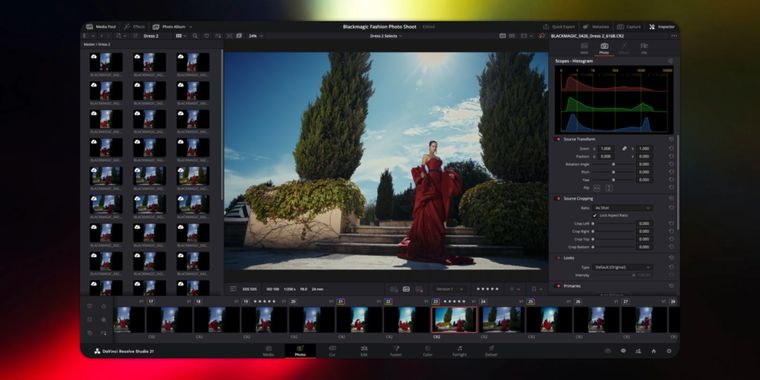

DaVinci Resolve 21 introduces new full blown photo editing tools to compete with Lightroom
Blackmagic has just landed one of the most massive updates for DaVinci Resolve with version 21, unexpectedly giving its already powerful video editor full blown photo editing capabilities that put it closer to Lightroom and other dedicated photo editors. The new Photo page lets photographers and colorists edit RAW images with Resolve’s node based grading workflow, using serial, parallel, and shared nodes for complex edits or applying the same look across an album. It also supports cropping and reframing at the original resolution and aspect ratio, while preserving file quality in a non-destructive style workflow.
Photo editing features include Resolve FX and Open FX plug-in support, LUTs, AI Magic Mask for one click object or person masking, manual selection tools for local edits, and AI UltraSharpen for upscaling low resolution photos and videos. Resolve 21 also adds a LightBox view for browsing albums, filters for edit status, star ratings, flags, and clip colors, album creation by shoot day or camera model, Lightroom catalog imports, and tethered capture for compatible Sony and Canon cameras with controls for ISO, exposure, and white balance.
Beyond the new photo editor, DaVinci Resolve 21 also introduces several AI upgrades for video editing. IntelliSearch can find objects, dialogue keywords, and people inside clips, while AI CineFocus lets editors simulate depth of field and rack focus effects with adjustable aperture, focal range, and keyframes. The update also adds speech generation from text or recorded voice samples, AI Face Age Transformer, AI Face Reshaper, AI Blemish Removal, AI Motion Deblur, and improved AI UltraSharpen for low quality or slightly out of focus footage. The public beta is available now for free, with a free version planned and the full studio version priced at $295.





- Video Editor
- Freemium
- Proprietary
Related news
External links
- DaVinci Resolve 21Blackmagic Design • Official source
- DaVinci Resolve 21 Adds Photo Editing and AI Search Tools - MacRumorsMacRumors
- DaVinci Resolve 21 is Now a Lightroom Alternative: RAW Editing, Tethering, Masking, and MorePetaPixel
- DaVinci Resolve 21 lands with Hollywood-level "Photo" feature and massive AI upgradesNeowin
- Blackmagic's DaVinci Resolve 21 takes on Adobe Lightroom with a new Photo pageEngadget
- DaVinci Resolve adds new photo editing tools to take on Lightroom and PhotoshopThe Verge
- DaVinci Resolve 21: Photo page, AI tools and 100+ new featuresRedSharkNews
Comments
As someone who uses Resolve for video work, this is exciting news. Having photo and video editing in one app simplifies the workflow so much. Curious if the tethered shooting works well in practice — that could be a game changer for studio photographers.