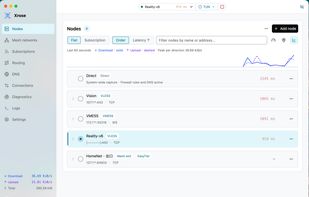
Xrose (pronounced k'rose or ex-rose) is a native, cross-platform desktop proxy and mesh networking client developed under Project Xristina. Built with Rust and GPUI Kit, it provides low resource overhead and native window rendering across Windows, macOS, and Linux, supporting platform-specific effects such as macOS vibrancy, Windows Mica/Acrylic, and Linux Wayland blur.
Core Capabilities
Dual Proxy Cores & Hot-Reloading: Compiles a unified configuration model for both sing-box (1.12+) and Xray (1.8+) cores. It supports mainstream proxy protocols, pre-execution configuration validation, hot-reloading, and subscription imports via Base64, share links, Clash YAML, SIP008, sing-box JSON, and QR code scanning.
Integrated Mesh Networking: Features built-in support for both EasyTier and Tailscale (including custom control servers), allowing simultaneous operation alongside proxy cores. Capabilities include exit node routing, subnet routing, bidirectional TCP/UDP port forwarding, MagicDNS integration, and peer-to-peer configuration sharing.
Three Independent Operation Modes:
Direct Mode: Handles daily traffic monitoring, ad-blocking rulesets, encrypted DNS, and mesh routing without requiring proxy nodes.
Proxy Mode: Manages multi-protocol nodes and rule-based traffic routing with latency-based, throughput-based, or failover outbound groups, alongside system proxy, PAC, and TUN support.
Mesh Mode: Routes system-wide traffic through a designated remote mesh exit node via TUN while suspending local proxy routing rules.
Real-Time Observability & Security: Offers live connection tracking, per-process traffic statistics, network diagnostics, and a privacy mode that masks sensitive network identifiers. Privileged network operations (such as TUN interface creation) are isolated in a background privilege helper daemon, while sensitive credentials and traffic logs are stored encrypted. Additionally, xrose-cli provides a headless interface for scripting and configuration verification.








No comments or reviews, maybe you want to be first?