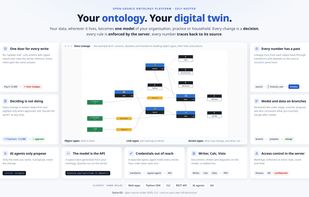
An open-source, self-hosted ontology platform. Your data becomes one model you own: typed, linked, changed only through rules the server enforces, and every number traces back to its source.
How it works:
Three ideas carry the whole platform: object types, link types and action types.
- Object types: what is there
You start by saying what exists: a lot of hay, from one field and one cut; a sale, to one buyer. Each is a typed thing with a kind and a key.
Nobody types or counts :in-barn: it is the bales made minus every bale sold, computed by the server. :bales is an integer, so "about forty" or -3 is refused before anything is written.
An object type is a typed table with a name, a face in the UI and a class in the generated SDK. Properties are typed, constrained and can be derived, so a value nobody typed in still shows up like any other column.
- Link types: who belongs to whom
A sale on its own is just a number. A sale linked to the lot it came out of is a fact everyone can see.
The sale names its lot and the link follows it: from the lot you see its sales, from a sale its lot, and :connected-sum above sums across that link. One line, and the barn knows what is in it.
Links are first-class: named in both directions, navigable in the UI, traversable in the SDK (lot.sales), and usable in derived values, filters and object sets.
- Action types: what you're allowed to do
In most systems anybody may change anything, and nobody can say who did. Here there is no "update row". There are only actions: named decisions with typed inputs and rules the server enforces. Selling hay is one of them, and it has a condition.
Ask to sell more bales than are in the barn and the server refuses and says why, with the same sentence for the phone, the CLI, the Python script and the AI agent. A refused action writes nothing. Every sale records who made it, and nobody can put someone else's name there.
Actions are the only write path: typed parameters, validation, submission criteria and state transitions, defined once and enforced everywhere.
Every rule you would otherwise keep in your head has this shape: a fact the server computes, and an action that checks it. Declare it once, and stop remembering it.
The same three ideas run the arable side of the farm. A field's margin is derived from its paid harvests and the hay sold off it, two links away. A harvest moves from planted to harvested, delivered and paid only through its actions, and Sell harvest refuses to run without a signed delivery note and a quality test of your own.






 Paul added Sutra-OS as alternative to InfoRapid KnowledgeBase Builder, Protégé and Onto4ALL


No comments or reviews, maybe you want to be first?