SQLBI Whiteboard
SQLBI Whiteboard is a native Windows 11 whiteboard application, built with C# and WPF and released as open source under the MIT license. It works entirely offline: boards are saved as local .wboard files, and no account or cloud service is required.
Cost / License
- Free
- Open Source (MIT)
Platforms
- Windows
Features
- Ad-free
- Drawing Tablet Support
- Pressure Sensitivity
- Optimized for Touch screen
SQLBI Whiteboard News & Activities
Recent activities
- marcosqlbi added SQLBI Whiteboard
marcosqlbi added SQLBI Whiteboard as alternative to Microsoft Whiteboard
SQLBI Whiteboard information
What is SQLBI Whiteboard?
SQLBI Whiteboard is a native Windows 11 whiteboard application, built with C# and WPF and released as open source under the MIT license. It works entirely offline: boards are saved as local .wboard files, and no account or cloud service is required.
The canvas is an unbounded surface with low-latency, pressure-aware pen ink, including rear-eraser support and basic palm rejection. Touch is used for panning and pinch zoom, with optional one-finger drawing; mouse and keyboard are fully supported.
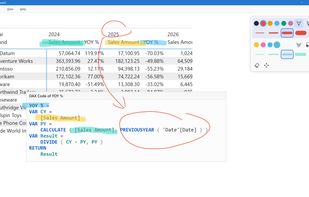
Beyond ink, boards hold containers: imported or pasted images, text blocks, and LiveView captures — live GPU-backed views of another application window or display that can be frozen, annotated, and resumed. Text containers support plain text, DAX, and SQL Server modes with live syntax highlighting and one-key code formatting, which makes the app particularly suited to teaching and presenting data topics. Strokes that belong to a container move, resize, and delete with it, and every operation participates in undo/redo.
Boards can also be generated from .wimport files — Markdown recipes whose headings, images, and code fences become laid-out containers — and .wboard files embed a preview image that shows as the file thumbnail in Explorer and in the companion VS Code extension.
The application is free, with no paid tiers. It is distributed through the Microsoft Store, as signed MSI installers (per-machine or per-user), and as a portable ZIP; source code is on GitHub.