Song Cage is a desktop songwriting application that merges chord progression building, lyric composition, music theory guidance, and melody creation on a unified DAW-style canvas. It serves guitar and piano songwriters who need to capture ideas quickly while keeping harmonic, melodic, and lyrical elements connected in a single interface.
The application features a context-aware chord palette with thirty-seven functionally organized chords, including diatonic options, parallel-mode borrowings, and secondary dominants with resolution indicators. Users select a key and receive harmonically relevant choices labeled by Roman numeral analysis and modal origin. The palette adapts to melodic input or chord placement, ranking suggestions by voice-leading smoothness and harmonic function. Each chord offers multiple voicings with precise guitar fingering diagrams—open positions, barre shapes, jazz voicings—and keyboard layouts for piano, along with capo transposition support. A modulation panel maps pivot-chord routes between keys, illustrating common-tone relationships and cadential patterns. Chord extensions such as major seventh, suspended second, and added ninth are available for each base quality.
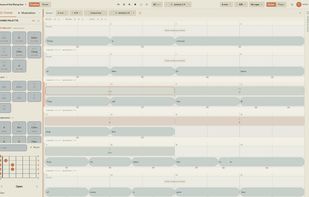
The timeline canvas functions as a drag-and-drop workspace where chord blocks and lyric sections can be repositioned and designated as verse, chorus, or bridge. A sheet view displays chords above lyrics in text format while a timeline view places syllables on a beat grid with assignable pitch values. Melody input snaps to chord tones automatically and highlights scale degrees relative to active harmony. Audio recording captures performances directly within the application, and playback includes accompaniment generation based on the chord progression. The lyric workspace integrates word tools that provide perfect rhymes, slant rhymes grouped by syllable count, synonyms, semantically related words, and verb or noun derivatives. An Explore tab features a Word Collider that generates unexpected word pairings to address creative blocks. Unlimited undo and redo preserve a complete editing history throughout each session.
Song Cage runs in desktop browsers with no installation required for the demo and full functionality on desktop. It does not require prior music theory knowledge, as contextual explanations accompany every chord suggestion with functional analysis labels, voice-leading assessments, and chord-tone alignment details. The design allows songwriters to begin with any element—a chord progression, a melody fragment, or a lyric line—without prescribed sequencing or setup. MIDI export enables transfer of harmonic and melodic data to external applications, and PDF export generates chord sheets in standard notation format for print or digital distribution. Collaborative and sharing permissions are managed through share links and email invitations for team-based workflows.







 otherr added Song Cage as alternative to Hookpad, Waveform, Helio Workstation, ChordieApp and 17 more


 Digital Candy LLC

Comments and Reviews
Been writing songs for a few years and my workflow was always a mess — voice memo for melody, notes app for lyrics, random Google searches for chord ideas. By the time everything was open, the moment was gone. Song Cage puts it all in one place. The chord palette is what I use most — it shows what fits in your key but also goes deeper with borrowed chords and modulation routes. I didn't know what those were when I started, but you pick it up just by using them. The lyric tools are solid too: click a word and you get rhymes, slant rhymes by syllable count, synonyms — all in context, not a separate tab. No AI generating stuff for you either, which I appreciate. It's a tool that helps you think, not one that thinks for you. Worth it if you write regularly.