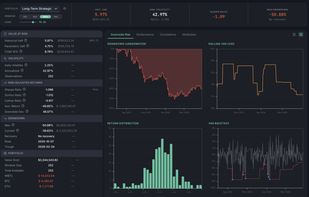
Sentralis gives self-directed crypto holders a clear, quantified picture of how the risk profile of their portfolios behaves. It measures where the risk actually sits, which assets drive it, how the book responds to changes in prices, correlations, liquidity and macro conditions, and what a proposed reallocation would do to those numbers.
Sentralis is read-only and non-custodial. It does not execute trades, hold funds, or make recommendations.
9 Scenario engines
Instant Shock: applies price moves independently or correlated
Monte Carlo: simulates return paths and reports Value at Risk, Expected Shortfall and drawdown distributions.
Historical Event Replay: runs the current portfolio through recorded market periods such as March 2020, Terra/Luna and FTX.
Liquidity & Exit Stress: sizes exit timelines and slippage with a market-impact model.
Correlation Regime Stress: recomputes portfolio behavior under a chosen correlation regime.
Factor Shock Analysis: decomposes exposure into BTC, ETH and SOL factors, or PCA factors.
Sector Concentration & Stress: classifies holdings by sector and measures concentration and spillover.
Macro Sensitivity Analysis: relates portfolio returns to SPY, DXY, HYG, TLT and VIX.
Counterparty & Infrastructure Risk: maps exposure to exchanges, chains and DeFi venues.
6 Risk Workbenches
Portfolio Teardown: a sectioned report on the portfolio's risk profile with traceable evidence for each finding.
Event Decomposition: splits a market event into distinct risk branches that can each be analyzed on its own.
Risk Time Machine: replays the current portfolio through historical market-data snapshots to show when and where its risk profile shifted.
Risk Delta Autopsy: attributes a change in modeled risk to market moves, composition changes and their interaction.
Marginal Risk Explorer: shows how resizing individual positions moves each risk metric.
Pre-Mortem: enumerates, quantifies and ranks the mechanisms that matter most for this specific portfolio.
Plus: alerts, reports, contextual and user-aware intelligence







 Sentralis added Sentralis as alternative to CoinStats, Cryptorai, Crypto Viewer and CoinTracker Crypto Portfolio
 Sentralis

