


A dev-first open source autonomous AI agent framework. Enabling developers to build, manage & run useful autonomous agents quickly and reliably.
Cost / License
- Free
- Open Source (MIT)
Application typeApplication types
Platforms
- Online
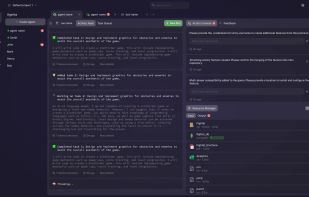


Apps similar to Second Me include SuperAGI, which is free and open source. Other options are DeepPavlov, ConvLab, Virtual Human Toolkit and Olympus. In total there are nine Large Language Model (LLM) Tools like Second Me for self-hosting and the web.
A dev-first open source autonomous AI agent framework. Enabling developers to build, manage & run useful autonomous agents quickly and reliably.

DeepPavlov is an open-source conversational AI library built on TensorFlow and Keras. It is designed for:
 Russia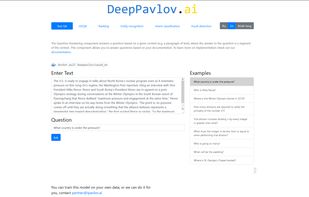


ConvLab is an open-source multi-domain end-to-end dialog system platform, aiming to enable researchers to quickly set up experiments with reusable components and compare a large set of different approaches, ranging from conventional pipeline systems to end-to-end neural models...


A collection of modules, tools, and libraries designed to aid and support researchers and developers with the creation of virtual human conversational characters.


Olympus was created at Carnegie Mellon University (CMU) during the late 2000's and benefits from ongoing improvements in functionality. Its main purpose is to help researchers interested in conversational agents to implement and test their ideas on complete systems without...


PyDial is an open-source end-to-end statistical spoken dialogue system toolkit which provides implementations of statistical approaches for all dialogue system modules. Moreover, it has been extended to provide multi-domain conversational functionality.


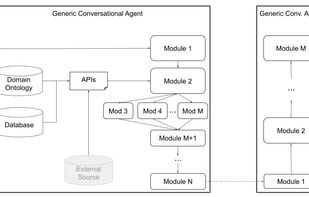
The Plato Research Dialogue System enables experts and non-experts alike to quickly build, train, and deploy conversational AI agents.
 United States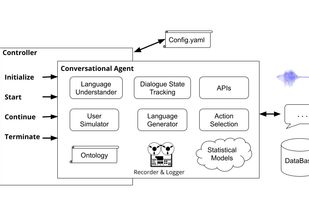


 Germany
 EU
EU


 United Kingdom


