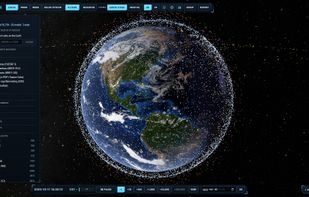
Perigee shows, in real time, the artificial objects orbiting the Earth, the Moon and Mars, and the spacecraft travelling through the solar system. Positions are computed in your browser from public data (CelesTrak, NASA/JPL Horizons, astronomy-engine). The site works in English and French (Périgée), and offline once visited.
Up close
3D models: the ISS, Hubble, the Mars rovers, some 45 other spacecraft and four asteroids (NASA 3D Resources) replace their marker up close; follow one and the camera comes to a few times its size. Attitude is illustrative.
Pictures: some 180 probes, comets, asteroids, landing and launch sites and satellites without a 3D model show a photo or artist’s impression (Wikimedia Commons, NASA, ESA, LROC), with author and licence.
Bodies: NASA and USGS maps of the planets and moons, giants and small bodies with their real flattening, irregular moons from shape models, the rings of Saturn, Uranus and Neptune. The Sun shows its figures, rotation and the day’s active regions. A switch shows Titan in visible or near infrared, Venus by cloud tops or radar surface.
Landing and impact sites on the Moon, Mars, Mercury, Venus and Titan: tick the box in a body’s panel to mark and list them, then pick one for its date, mission and picture.
Immersive effects (high quality, each switchable): relief (Moon, Mars, Mercury, Ceres), Earth clouds with shadows, winds on Venus and the giant planets, sunspots where NOAA reported them, and spacecraft lit by the Sun alone, with their own shadows and that of their body.
Comets: tick Show the comets for 20 comets, famous ones (Halley, 67P, Hale-Bopp, Tsuchinshan-ATLAS…) and current telescope targets, by estimated brightness, with orbits (open ones too) and illustrative ion and dust tails. Panels give perihelion, period, distances, magnitude and, for 15, a photo.
Asteroids: tick Show the notable asteroids for the largest (Vesta, Pallas, Hygiea…) and those visited by spacecraft (Eros, Itokawa, Ryugu, Bennu, Didymos, Dinkinesh…). Panels give size, rotation, moons, missions and orbit; Vesta, Bennu, Eros and Itokawa have a NASA shape model, most others a picture.
Retired spacecraft: an Inactive spacecraft section lists ended missions (Pioneer 10 and 11, Ulysses, Spitzer, Kepler, Gaia, Cassini, Rosetta, Dawn…), on their predicted path when JPL Horizons still follows them, otherwise with their story. Hidden by default: tick them one by one or with Show all.
Named stars: tick Identify the bright stars to label the 93 brightest, or Identify the stars within 20 light-years for the Sun’s 57 nearest neighbours; click a name for distance, type, size, temperature and luminosity, with the star beside the Sun to scale.
Star map: click a star’s illustration for a 3D map of it and the Sun, every named star at its real distance, with rings and stalks showing the Milky Way’s plane. Click another star to compare, turn the map or look along the galactic axes, in perspective or orthographic view.







 dflamarre added Perigee as alternative to Stellarium, Celestia, Sky Map and Gaia Sky

 David Fugère-Lamarre


No comments or reviews, maybe you want to be first?