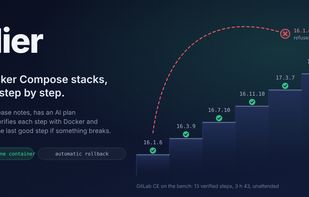
Palier updates the Docker Compose stacks of a machine on its own. It does more than bump a tag: it reads the release notes of every skipped version and the security advisories, has an AI build a plan, checks that plan, then applies it in steps. If a step fails, the whole stack goes back to the last step that worked.
What it handles: required intermediate versions, Compose file changes asked by the release notes (a removed service, a renamed variable, a replaced image), and major version upgrades of PostgreSQL, MySQL and MariaDB by export and reimport on a new volume. A database never goes beyond what its application says it supports.
The AI picks operations from a closed list and never writes a command. Every claim in its plan must quote a release note word for word, and the code rejects the plan otherwise. Before each step, Palier takes a restore point (Compose files, .env, images, volume copies). After each step, it verifies with what Docker reports.
One Go binary, one container, the Docker socket. No agent, no account, no license. It needs a language model to read the notes: your own API key, or a local model through an OpenAI-compatible API such as Ollama.
Limits: Compose stacks only, one instance per machine, release notes read on GitHub and gitlab.com only.






 EU


 benjy33000 added Palier as alternative to WUD (What's Up Docker?), Diun and WatchTower
 Benjamin Touchard



No comments or reviews, maybe you want to be first?